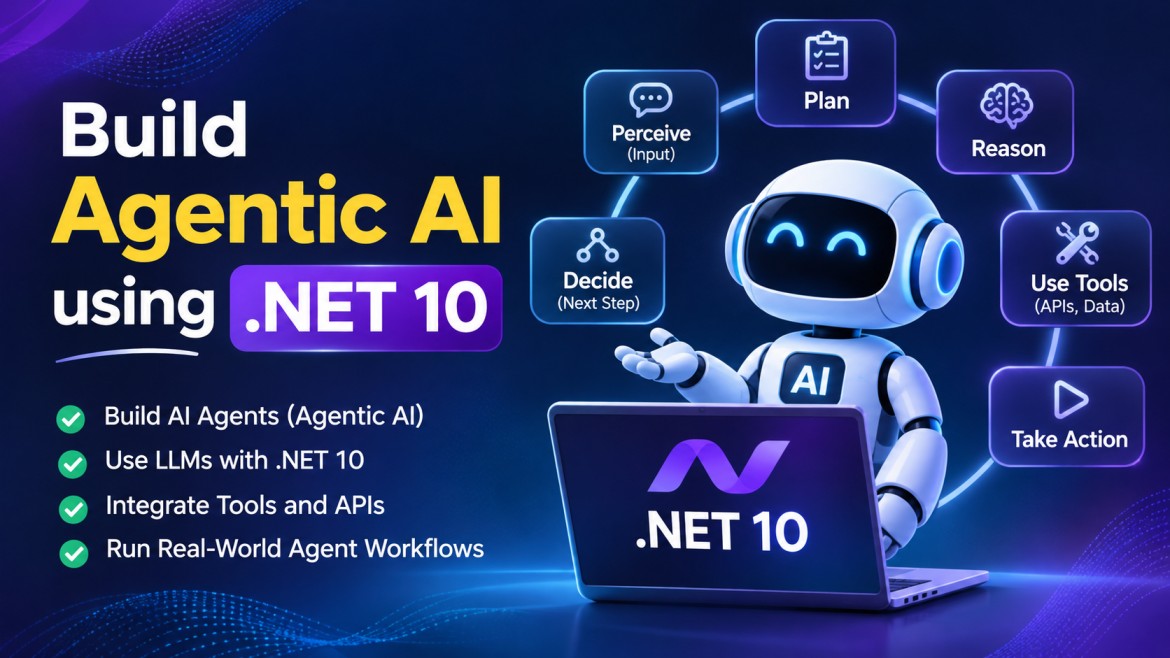


AI Agents and the Paradigm Shift in Software Development
The software industry is going through a major shift from traditional deterministic software to AI-native and agentic systems. For many years, applications were mainly built as monolithic systems. These systems were predictable and relatively straightforward, but as applications became larger, they became tightly coupled and difficult to scale and maintain.
The industry then moved toward microservices, cloud-native architecture, event-driven systems, and API-based integration. Instead of one large application, functionality was divided into smaller services such as Customer, Order, Payment, and Inventory. This provided better scalability, flexibility, and independent deployment.
However, even modern microservices are fundamentally deterministic. Developers define the workflow using code, business rules, if-else conditions, APIs, and predefined processes. The application executes the steps that developers have already designed.
Why Traditional Architecture Has Limitations
The problem appears when business requirements become highly dynamic. In a traditional application, every possible workflow usually needs to be explicitly designed and implemented. If a new business scenario appears, developers often need to add new conditions, APIs, DTOs, routing logic, and integration code.
For example, a customer-support application might have a predefined process for checking an order. But a real customer could ask about a delayed shipment, duplicate payment, missing delivery, refund, or several problems at the same time. Each situation may require a different sequence of actions. Hard-coding every possible path can make the system increasingly complex.
Traditional systems also depend heavily on humans for decision-making. The application may collect information, generate reports, and display dashboards, but a person often needs to examine the information and decide what action should be taken. The software acts primarily as a tool, rather than an autonomous actor.
The Rise of AI Engineering
This situation led to the growth of AI Engineering. Traditionally, AI was strongly associated with data scientists who worked with datasets, model training, statistics, and machine-learning algorithms, often using environments such as Jupyter notebooks.
The arrival of Large Language Models (LLMs) changed this. AI moved beyond research and needed to be integrated into real production applications. This created a stronger need for developers and architects who understand both AI and traditional software engineering.
AI engineering is therefore not simply about training models. It involves connecting LLMs with existing backend systems, APIs, databases, security, cloud infrastructure, and business processes.
For a .NET developer, this means your existing knowledge of C#, ASP.NET Core, Web API, Clean Architecture, Dependency Injection, microservices, SQL Server, Azure, and security remains highly valuable.
Deterministic vs Probabilistic Systems
Traditional software is primarily deterministic. If you provide the same input and conditions, the application follows the rules written by the developer.
Input → Business Rules → Code → OutputLLMs are different because they are probabilistic. They interpret context and generate responses based on patterns learned during model training.
Input → LLM → Reasoning/Prediction → OutputAgentic AI combines these two worlds. The AI provides flexible reasoning, while traditional software provides the controlled environment, APIs, databases, security, and business rules.
The Control Flow Changes
One of the most important ideas in the transcript is "reversing the control flow."
In traditional software, the developer defines the complete sequence:
Step 1 → Step 2 → Step 3 → Step 4In an agentic system, the developer provides the goal, instructions, context, and available tools, and the agent determines which actions are necessary.
Goal
 ↓
Agent
 ↓
Decide what to do
 ↓
Use Tool
 ↓
Observe Result
 ↓
Decide Next Action
 ↓
Complete Goal
For example, instead of programming exactly how to investigate a delayed order, we can give an agent tools such as GetOrder(), GetShipment(), GetPayment(), and CreateSupportTicket(). The agent can determine which tools it needs based on the customer's situation.
This doesn't mean developers stop controlling the system. Developers still define the agent's boundaries, permissions, tools, instructions, and security controls.
What Is an AI Agent?
An AI agent is an AI-based software component that receives a goal, uses an LLM for reasoning, interacts with tools, observes results, and determines what to do next.
A simplified agent contains:
Goal
 ↓
System Instructions
 ↓
LLM
 ↓
Memory / Context
 ↓
Tools
 ↓
Actions
 ↓
Results
For example, a customer-support agent could receive the goal:
"Help the customer resolve their delayed order."
The agent may decide to retrieve the order, check shipment information, investigate the delivery status, create a support ticket, and then communicate the result to the customer. The exact sequence can change depending on what it discovers.
Agents and Tools
An LLM by itself cannot automatically access your company's internal systems. Tools provide that capability.
For example:
GetCustomer()
GetOrder()
GetPayment()
GetShipment()
CreateTicket()
SendEmail()
The agent can decide which tool is appropriate for the current task. This is a major difference between a simple LLM application and an agentic application.
A normal LLM might answer:
"Your order appears to be delayed."
An agent with appropriate tools could actually investigate the order, check the shipment system, create a support ticket, and send a notification.
Agents as Independent Actors
The transcript compares agents with microservices. A microservice normally owns a particular business capability, while an agent can own a particular decision-making responsibility.
For example:
Order Service
→ Order business logic

Order Agent
→ Understand order-related goals
→ Reason about required actions
→ Use order-related tools
An agent can have its own system instructions, memory, tools, context, and permissions. Multiple specialized agents can also collaborate in a larger workflow.
For example:
Supervisor Agent
       ↓
 ┌─────┼─────┐
 ↓     ↓     ↓
Order Payment Shipping
Agent  Agent   Agent
This is the foundation of multi-agent architecture.
MCP and Agent Integration
Traditional applications generally integrate through explicitly defined REST APIs. Developers write API clients, DTOs, authentication logic, routing, and data mapping for each integration.
The transcript introduces MCP (Model Context Protocol) as an interoperability approach for AI applications. MCP provides a standardized way for AI applications to interact with tools and contextual resources. This becomes useful when an agent needs access to many different capabilities and enterprise systems.
Conceptually:
AI Agent
   ↓
  MCP
   ↓
Tools / APIs / Resources
MCP does not mean REST APIs disappear. Instead, it provides another standardized layer for exposing capabilities to AI systems.
Why Enterprises Are Moving Toward Agentic AI
Enterprises increasingly want software that can do more than simply store and display information. They want systems that can understand unstructured information, make decisions, and execute multi-step workflows with less human intervention.
For example, instead of:
Application → Report → Human Decision → Actionan agentic system can potentially perform:
Goal → Agent → Reason → Tool → Observe → Act → CompleteThis is particularly useful for customer support, research, document processing, IT operations, business-process automation, and other situations where the required workflow is not completely predictable.
When Should You Use an AI Agent?
An agent is a good choice when the goal is clear but the exact steps required to achieve that goal can vary.
For example:
"Investigate why this customer's order has not arrived and resolve the problem."
The system may need to check the order, shipment, payment, delivery information, or support history. The required sequence depends on what it discovers.
An agent is also useful when the application must understand natural language or unstructured data, use multiple tools, perform reasoning, and dynamically decide what action should happen next.
The important principle is:
If you know the goal but cannot easily define the exact workflow beforehand, Agentic AI may be a good fit.
When Should You NOT Use an AI Agent?
You should not use an agent simply because AI is available.
If the problem is simple, predictable, deterministic, and rule-based, traditional software is normally better. For example, calculating an order total, validating a password, retrieving a customer by ID, processing a simple CRUD request, or calculating tax does not require an LLM to decide what to do.
For example:
var total = subtotal - discount + tax + shipping;There is no reason to ask an AI agent to make this calculation. Traditional code will be faster, cheaper, easier to test, and more predictable.
Similarly, if your workflow is always:
Create Order
 ↓
Process Payment
 ↓
Reserve Inventory
 ↓
Generate Invoice
 ↓
Send Email
you can implement this using normal .NET services, APIs, queues, or workflow orchestration. Introducing an AI agent would add unnecessary complexity.
Simple Classification
The easiest way to classify a problem is:
| Type | Best Approach |
|---|---|
| Fixed rules and predictable workflow | Traditional software |
| Generate or understand content | Generative AI |
| Dynamic goal requiring reasoning and actions | AI Agent |
| Multiple specialized AI responsibilities | Multi-Agent System |
So, don't replace traditional software with AI unnecessarily. The strongest architecture will often combine both.
The Key Message for a .NET Developer
The important message from this transcript is that Agentic AI is not a replacement for software engineering. It is another architectural layer built on top of strong software-engineering foundations.
Your existing knowledge can evolve like this:
C# / .NET
    ↓
ASP.NET Core
    ↓
Web API
    ↓
Clean Architecture
    ↓
Microservices
    ↓
Azure / Cloud
    ↓
LLM
    ↓
RAG
    ↓
Tool Calling
    ↓
AI Agents
    ↓
MCP
    ↓
Multi-Agent Architecture
The fundamental shift is:
Traditional software tells the system how to execute. Agentic software gives the system a goal, tools, context, and boundaries, allowing the AI to determine the appropriate sequence of actions.