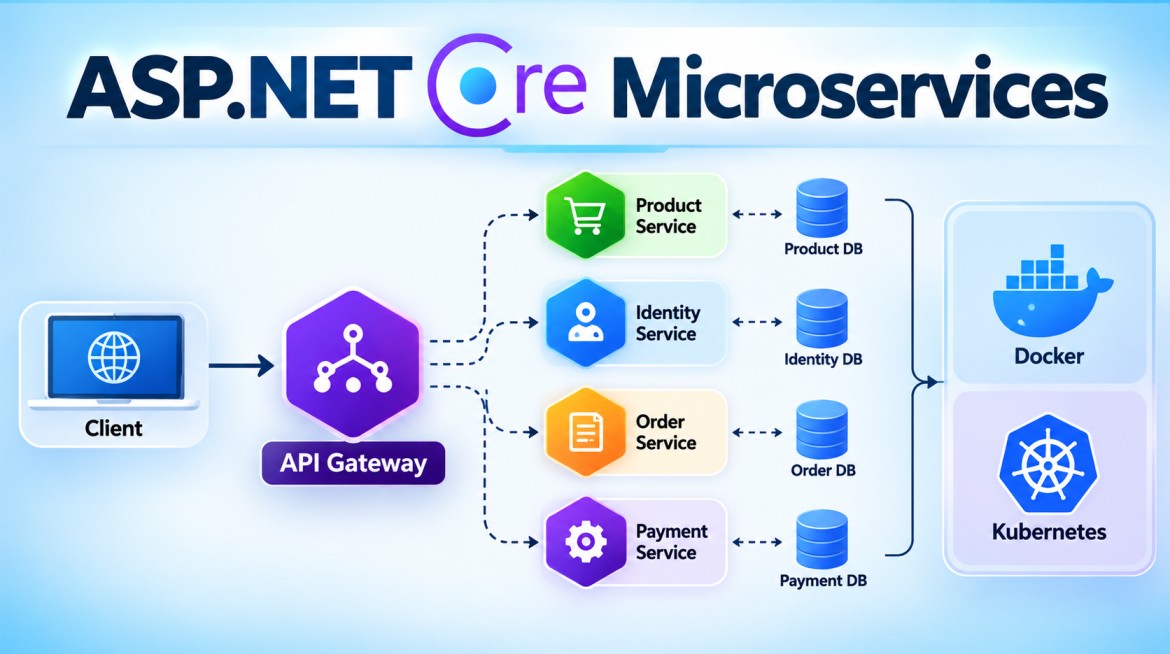


API Gateway vs Load Balancer — What is the Difference?
Both API Gateway and Load Balancer sit between clients and backend applications, but they solve different problems.
The simplest distinction is:
API Gateway decides which service should handle the request. A Load Balancer decides which instance of that service should handle the request.
1. What is an API Gateway?
An API Gateway is a centralized entry point that receives client API requests and routes them to the appropriate backend service or microservice.
Consider an e-commerce system:
                         ┌──► Product Service
                         │
Client ──► API Gateway ──┼──► Order Service
                         │
                         ├──► Payment Service
                         │
                         └──► Customer Service
For example:
GET  /products      → Product Service
POST /orders        → Order Service
POST /payments      → Payment Service
GET  /customers/10  → Customer Service
The gateway understands the API routes and determines which service should receive the request.
Examples in the .NET ecosystem include Ocelot and a gateway built using YARP.
Why do we need an API Gateway?
Suppose your system has 20 microservices.
Without a gateway:
Angular
   │
   ├── https://product-api/api/products
   ├── https://order-api/api/orders
   ├── https://payment-api/api/payments
   └── https://customer-api/api/customers
The client may become tightly coupled to individual service addresses and APIs.
With a gateway:
Angular
   │
   ▼
https://api.company.com
   │
   ├── /products
   ├── /orders
   ├── /payments
   └── /customers
The gateway hides much of the internal service topology from the client.
Purpose of API Gateway
An API Gateway primarily provides API-level traffic management and cross-cutting policies.
Common responsibilities include:
- Routing
- Authentication integration
- Authorization
- Rate limiting
- Request/response transformation
- Header manipulation
- API aggregation
- Logging/tracing integration
- Caching, depending on the gateway
- Service discovery integration
- Load balancing, depending on the gateway
For example:
Client
   │
   ▼
┌─────────────────────────┐
│       API Gateway       │
│                         │
│ Authentication          │
│ Authorization           │
│ Rate Limiting           │
│ Routing                 │
│ Transformation          │
│ Logging / Tracing       │
└────────────┬────────────┘
             │
       ┌─────┼─────┐
       ▼     ▼     ▼
    Product Order Payment
2. What is a Load Balancer?
A Load Balancer distributes incoming traffic across multiple instances of an application or service.
Suppose your Product Service has three instances:
Product Service

Server 1 → 10.0.0.10
Server 2 → 10.0.0.11
Server 3 → 10.0.0.12
Instead of clients choosing a server:
                       ┌──► Product Instance 1
                       │
Client ─► Load Balancer├──► Product Instance 2
                       │
                       └──► Product Instance 3
The Load Balancer selects an appropriate healthy instance.
Why do we need a Load Balancer?
Imagine one API server can comfortably process:
1,000 requests/secTraffic increases substantially.
Instead of relying on one larger server, we can run multiple instances:
                  ┌── Server 1
                  │
Requests ──► LB ──┼── Server 2
                  │
                  ├── Server 3
                  │
                  └── Server 4
This enables horizontal scaling.
Purpose of a Load Balancer
The major purposes are:
- Distribute traffic
- Improve scalability
- Improve availability
- Detect unhealthy instances
- Avoid unhealthy instances
- Support horizontal scaling
- Reduce overload on individual servers
For example:
100 requests
     │
     ▼
Load Balancer
     │
     ├──► Instance 1
     ├──► Instance 2
     └──► Instance 3
The exact distribution depends on the balancing algorithm and current state.
Load-Balancing Algorithms
Common algorithms include:
Round Robin
Requests are rotated through available instances:
Request 1 → Server A
Request 2 → Server B
Request 3 → Server C
Request 4 → Server A
Least Connections
Traffic is directed toward an instance with fewer active connections.
Weighted algorithms
More powerful instances can receive a larger share of traffic.
Example:
Server A → Weight 5
Server B → Weight 3
Server C → Weight 2
Hash / affinity-based approaches
A property such as a client/session key may be used to produce more stable routing to a backend where required.
Available algorithms vary by load-balancing product.
API Gateway vs Load Balancer
This is the key comparison.
| Feature | API Gateway | Load Balancer |
|---|---|---|
| Primary purpose | API management/routing | Traffic distribution |
| Routes to | Different services/APIs | Service/application instances |
| Understands API routes | Usually yes | Depends on L4/L7 LB |
| Authentication | Common | Usually not its primary role |
| Authorization | Common | Usually not |
| Rate limiting | Common | Product-dependent |
| Request transformation | Common | Limited/product-dependent |
| API aggregation | Possible | Generally no |
| Load balancing | Often possible | Core responsibility |
| Health checks | Often/integration | Core/common capability |
| Horizontal scaling | Indirectly | Major purpose |
| Typical decision | Which service? | Which instance? |
Most Important Difference
Consider:
/products
/orders
/payments
An API Gateway determines:
/products → Product Service

/orders   → Order Service

/payments → Payment Service
Now suppose Product Service has three instances:
Product Service
    │
    ├── Instance A
    ├── Instance B
    └── Instance C
A Load Balancer determines:
Product Service
       │
       ▼
Which instance?
       │
       ├── A
       ├── B
       └── C
Therefore, a useful interview memory aid is:
API Gateway
     ↓
Which SERVICE?

Load Balancer
     ↓
Which INSTANCE?
There can be overlap: modern Layer-7 load balancers can perform path/host-based routing, and gateways such as Ocelot/YARP can perform load balancing. The distinction is primarily their responsibility and abstraction level, not that the capabilities can never overlap.
Real-World Architecture
In a larger microservices system, you might have both:
                    Internet
                       │
                       ▼
                Load Balancer
                       │
             ┌─────────┼─────────┐
             ▼         ▼         ▼
          Gateway   Gateway   Gateway
         Instance 1 Instance 2 Instance 3
             │         │         │
             └─────────┼─────────┘
                       │
          ┌────────────┼────────────┐
          ▼            ▼            ▼
       Product       Order       Payment
       Service       Service      Service
Why put a Load Balancer before the API Gateway?
Because the API Gateway itself may need multiple instances.
Without that:
Client
   │
   ▼
Gateway
the gateway could become a single point of failure.
Instead:
Client
   │
   ▼
Load Balancer
   │
   ├── Gateway 1
   ├── Gateway 2
   └── Gateway 3
The gateway tier can then scale horizontally.
What Happens After the Gateway?
The backend services may also have multiple instances:
Client
   │
   ▼
External Load Balancer
   │
   ▼
API Gateway instances
   │
   ├──────── /products
   │             │
   │             ▼
   │       Product Service
   │        ├── Instance 1
   │        ├── Instance 2
   │        └── Instance 3
   │
   └──────── /orders
                 │
                 ▼
           Order Service
            ├── Instance 1
            └── Instance 2
Depending on the platform, backend balancing may be performed by YARP/Ocelot, Kubernetes Services, a service mesh, cloud infrastructure, or another load-balancing layer.
Example with Ocelot
Ocelot itself can perform downstream load balancing.
{
  "Routes": [
    {
      "UpstreamPathTemplate": "/gateway/products",
      "DownstreamPathTemplate": "/api/products",

      "DownstreamScheme": "https",

      "DownstreamHostAndPorts": [
        {
          "Host": "server1",
          "Port": 7001
        },
        {
          "Host": "server2",
          "Port": 7001
        },
        {
          "Host": "server3",
          "Port": 7001
        }
      ],

      "LoadBalancerOptions": {
        "Type": "RoundRobin"
      }
    }
  ]
}
Conceptually:
Client
   │
   ▼
Ocelot
   │
   │ /gateway/products
   ▼
Product Service
   │
   ├── Server 1
   ├── Server 2
   └── Server 3
So an API Gateway and Load Balancer are not mutually exclusive concepts. A gateway can include load-balancing functionality.
Example with YARP
YARP also supports multiple destinations in a cluster.
{
  "ReverseProxy": {

    "Routes": {
      "product-route": {
        "ClusterId": "product-cluster",
        "Match": {
          "Path": "/products/{**catch-all}"
        }
      }
    },

    "Clusters": {

      "product-cluster": {

        "LoadBalancingPolicy": "RoundRobin",

        "Destinations": {

          "server1": {
            "Address": "https://server1:7001/"
          },

          "server2": {
            "Address": "https://server2:7001/"
          },

          "server3": {
            "Address": "https://server3:7001/"
          }

        }
      }
    }
  }
}
Here:
Route
   ↓
product-cluster
   ↓
Load Balancer
   ↓
┌─────────┬─────────┬─────────┐
▼         ▼         ▼
Server 1  Server 2  Server 3
Layer 4 vs Layer 7 Load Balancer
This is an important interview topic.
Layer 4 Load Balancer
Works mainly with transport/network information such as:
IP address
TCP/UDP
Port
Conceptually:
Client
   │
   │ TCP :443
   ▼
L4 Load Balancer
   │
   ├── Server 1
   ├── Server 2
   └── Server 3
It generally does not need to reason about application routes such as /products.
Layer 7 Load Balancer
Works at the application layer, commonly understanding HTTP concepts such as:
URL
Path
Host
Headers
Cookies
HTTP methods
It can potentially route:
/products/* → Product backend

/orders/*   → Order backend
Now it starts to look similar to an API Gateway.
That is why the distinction is not simply:
"Load balancers cannot understand URLs."
Some Layer 7 load balancers absolutely can.
The difference is better understood in terms of the product's primary responsibility and policy model.
Advantages of API Gateway
- Single API entry point
- Centralized routing
- Authentication/authorization integration
- Rate limiting
- Request/response transformation
- Hides internal service topology
- API aggregation where supported
- Centralized cross-cutting API policies
Disadvantages of API Gateway
- Additional architectural component
- Can become a bottleneck if poorly designed
- Adds another network/process hop
- Configuration can become complex
- Gateway customizations require maintenance
- Requires high availability in production
Advantages of Load Balancer
- Horizontal scalability
- High availability
- Traffic distribution
- Health checking
- Failover
- Prevents individual instances from receiving all traffic
- Supports multiple application instances
Disadvantages of Load Balancer
- Adds infrastructure and operational complexity
- Can itself become a critical dependency if not highly available
- Layer 4 balancing has little application/API awareness
- Advanced L7 functionality can make configuration more complex
- Does not automatically provide the complete API-management functionality of an API Gateway
Key Points
For interviews, remember:
API Gateway:
Client
   ↓
API Gateway
   ↓
Which SERVICE?
Load Balancer:
Request
   ↓
Load Balancer
   ↓
Which INSTANCE?
Together:
Client
   │
   ▼
Load Balancer
   │
   ├── Gateway Instance 1
   ├── Gateway Instance 2
   └── Gateway Instance 3
              │
              ▼
       API Routing / Policies
              │
       ┌──────┼──────┐
       ▼      ▼      ▼
    Product  Order  Payment
Interview Questions & Answers
Q1. What is the difference between an API Gateway and a Load Balancer?
Answer:
An API Gateway primarily manages and routes API requests to different backend services, while a Load Balancer primarily distributes traffic across multiple instances of a service or application.
A simple way to remember it is:
API Gateway → Which service?
Load Balancer → Which instance?
Q2. Can an API Gateway perform load balancing?
Yes.
Gateways such as Ocelot and YARP-based implementations can distribute requests across multiple downstream instances.
Q3. If API Gateway supports load balancing, why do we need a separate Load Balancer?
Because the gateway itself may have multiple instances.
Client
   ↓
Load Balancer
   ↓
┌────────┬────────┬────────┐
▼        ▼        ▼
GW 1     GW 2     GW 3
A front-end load balancer can distribute incoming traffic across those gateway instances.
Q4. Can a Load Balancer route requests based on URL?
A Layer 7 Load Balancer can.
For example:
/products/* → Product backend
/orders/*   → Order backend
A Layer 4 Load Balancer primarily works with IP addresses, ports, and transport protocols rather than HTTP paths.
Q5. Is a Load Balancer the same as an API Gateway?
No.
Their features can overlap, especially at Layer 7, but their primary responsibilities differ.
The Load Balancer primarily focuses on traffic distribution and availability, while an API Gateway focuses on API routing and API-level policies.
Q6. Where should a Load Balancer be placed in a Microservices architecture?
A common architecture is:
Internet
   ↓
Load Balancer
   ↓
API Gateway instances
   ↓
Microservices
There can also be internal load-balancing mechanisms between the gateway and replicated Microservices.
Q7. Does every Microservice need a separate Load Balancer?
Not necessarily.
Modern platforms such as container orchestrators and cloud platforms can provide service-level load balancing automatically. The exact design depends on how the Microservices are deployed.
Interview-ready answer
An API Gateway and a Load Balancer solve different problems. An API Gateway acts as the entry point to APIs and routes requests to the appropriate service while applying API-level concerns such as authentication, authorization, rate limiting and transformations. A Load Balancer primarily distributes traffic across multiple instances to improve scalability and availability. In simple terms, the API Gateway determines which service should process a request, while the Load Balancer determines which instance of that service should process it. Their capabilities can overlap, especially with Layer-7 load balancers and gateways that provide built-in load balancing.