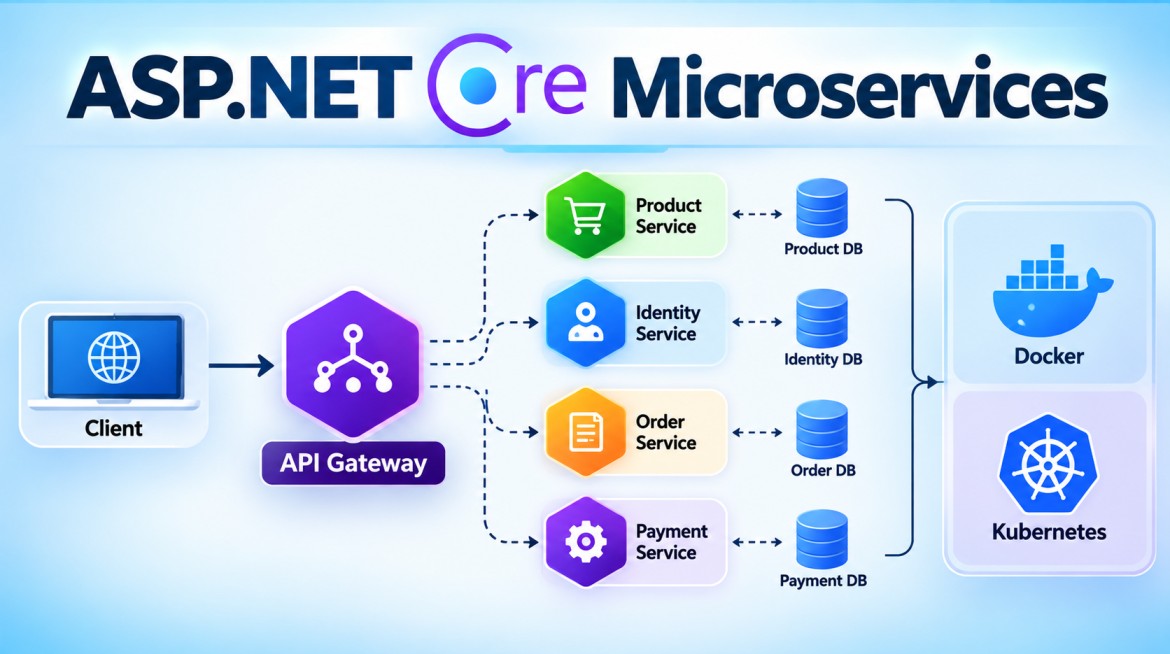


1. What is a Bounded Context?
A Bounded Context is a concept from Domain-Driven Design (DDD).
It defines a clear business boundary within which:
- Business terms have a specific meaning.
- Business rules are related.
- Data/models belong together.
- Responsibilities are clearly defined.
In Microservices Architecture, bounded contexts are commonly used to help identify good microservice boundaries.
Simple example
Consider an E-commerce system:
E-Commerce
   |
   ├── Order Context
   │     ├── Order
   │     ├── OrderItem
   │     └── OrderStatus
   │
   ├── Payment Context
   │     ├── Payment
   │     ├── Transaction
   │     └── Refund
   │
   └── Inventory Context
         ├── ProductStock
         ├── Warehouse
         └── StockReservation
Here, Order, Payment, and Inventory are different bounded contexts.
2. Why Do We Need Bounded Context?
In a large application, the same business term can mean different things to different parts of the business.
For example, consider Product.
Product Catalog Context
Product
 ├── Name
 ├── Description
 ├── Category
 ├── Images
 └── Price
Inventory Context
Product
 ├── ProductId
 ├── AvailableQuantity
 ├── ReservedQuantity
 └── Warehouse
Both contexts talk about a Product, but they care about different information and business rules.
Trying to create one huge Product model for the entire organization can create unnecessary coupling.
Bounded Context says:
Keep each domain model and its business rules within a clearly defined business boundary.
3. Purpose in Microservices
Bounded Context helps answer an important question:
Where should one microservice end and another microservice begin?
For example:
Order Bounded Context
        ↓
Order Service

Payment Bounded Context
        ↓
Payment Service

Inventory Bounded Context
        ↓
Inventory Service
This creates clear responsibilities.
However:
Bounded Context ≠ always exactly one Microservice.
A bounded context is primarily a domain/design boundary. Depending on system size and operational needs, it could be implemented as one service or potentially multiple services.
4. Simple Real-Time Example
Suppose a customer places an order.
Customer
   ↓
Order Service
   ↓
Order Created
   |
   ├────→ Payment Service
   |
   └────→ Inventory Service
Each bounded context has different responsibilities.
Order Context
Responsible for:
- Creating orders
- Order items
- Order status
- Order history
Payment Context
Responsible for:
- Processing payment
- Payment status
- Transactions
- Refunds
Inventory Context
Responsible for:
- Available stock
- Reserving stock
- Releasing stock
- Warehouse information
Instead of mixing all these rules together, each context owns its own domain logic.
5. Data Ownership
Bounded contexts also help establish data ownership.
Order Context
     ↓
Order Service
     ↓
Order DB


Payment Context
     ↓
Payment Service
     ↓
Payment DB
The Payment Service should generally not directly modify Order tables.
Instead:
Payment Service
      ↓
API / Event
      ↓
Order Service
This maintains loose coupling.
6. Bounded Context vs Microservice
This is an important interview distinction.
| Bounded Context | Microservice |
|---|---|
| DDD concept | Architecture/deployment concept |
| Defines business/domain boundary | Defines independently deployable service |
| Focuses on domain model and rules | Focuses on implementation and operation |
| Logical boundary | Deployment/runtime boundary |
| Helps identify service boundaries | Implements business capabilities |
Simple way to understand
DDD Analysis
     ↓
Identify Bounded Context
     ↓
Define Service Boundary
     ↓
Implement Microservice
7. Advantages
Using bounded contexts provides:
- Clear business boundaries
- High cohesion
- Loose coupling
- Clear data ownership
- Easier maintenance
- Better team ownership
- Independent evolution of domains
- Helps prevent overly large domain models
- Helps identify appropriate microservice boundaries
8. Disadvantages / Challenges
Bounded contexts also have challenges:
- Requires good understanding of the business domain.
- Boundaries can be difficult to identify initially.
- Business capabilities sometimes overlap.
- Communication between contexts must be carefully designed.
- Incorrect boundaries can create tightly coupled microservices.
- Boundaries may need to evolve as business requirements change.
9. Key Points
- Bounded Context comes from Domain-Driven Design (DDD).
- It defines a clear boundary for a business domain/model.
- Inside the boundary, terminology and business rules have consistent meaning.
- Different contexts can represent the same real-world concept differently.
- Bounded Context helps determine microservice boundaries.
- Each context should have clear responsibilities and data ownership.
- It promotes high cohesion and loose coupling.
- A bounded context does not necessarily equal exactly one microservice.
- Microservices from different contexts should communicate using well-defined APIs or events.
Easy way to remember
Business Domain
      ↓
Bounded Context
      ↓
Clear Business Responsibility
      ↓
Own Models + Rules + Data
      ↓
Potential Microservice Boundary
10. Interview Questions & Answers
Q1. What is a Bounded Context?
A Bounded Context is a DDD concept that defines a clear business boundary within which domain models, terminology and business rules have a consistent meaning.
Q2. Why is Bounded Context important in Microservices?
It helps identify logical service boundaries and prevents unrelated business responsibilities from being mixed into the same service.
Q3. Is a Bounded Context the same as a Microservice?
No.
A Bounded Context is a domain/design boundary, whereas a Microservice is an independently deployable architectural component.
Q4. Can the same entity exist in multiple Bounded Contexts?
Yes.
For example:
Catalog Context
Product → Name, Description, Price

Inventory Context
Product → ProductId, Stock, Warehouse
The concept is the same, but its model and meaning differ according to the context.
Q5. Can one Bounded Context contain multiple microservices?
Yes. Depending on complexity and operational requirements, a bounded context may be implemented using one or more services.
Q6. How do Bounded Contexts communicate?
Usually through clearly defined:
- REST APIs
- gRPC
- Domain/Integration Events
- Message brokers
Interview One-Line Answer
A Bounded Context is a DDD-defined business boundary within which domain models, terminology, rules, and data have a consistent meaning; it is commonly used to identify appropriate microservice boundaries.