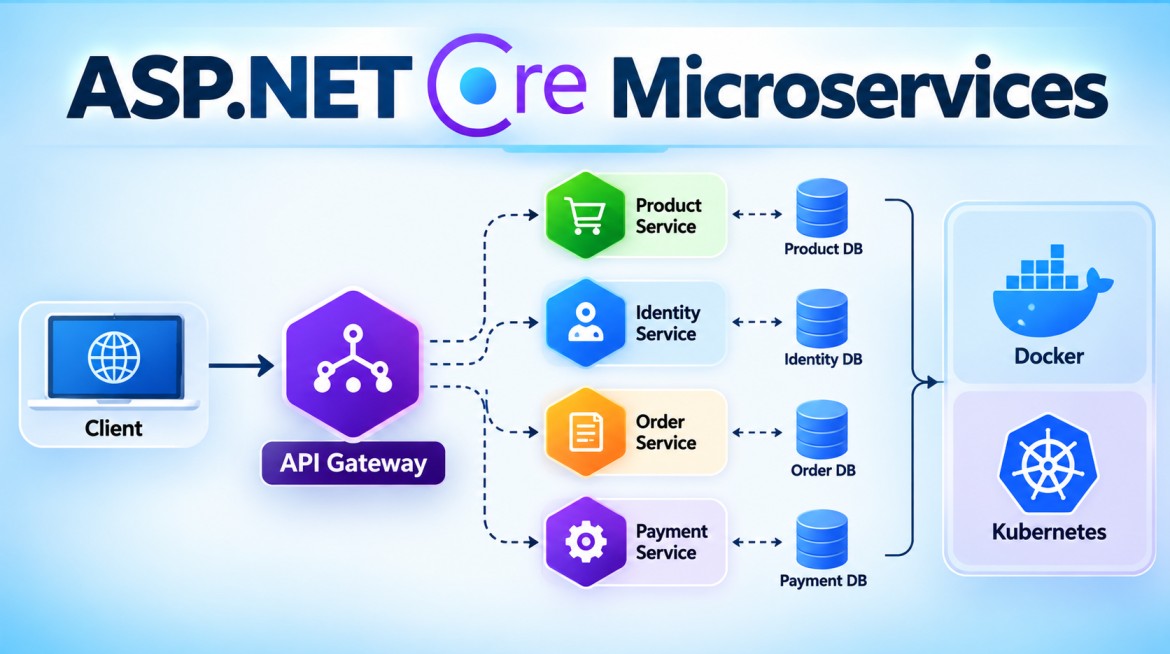


1. How Does One Microservice Locate Another Microservice Dynamically?
What is dynamic service location?
In a microservices architecture, services often run on multiple instances, and their network locations can change dynamically.
For example:
Order Service
      |
      | Needs product information
      v
Product Service
In a simple environment, OrderService could call a fixed address:
https://localhost:7002/api/products/10But in production, ProductService may have several instances:
Product Service
 ├── Instance 1 → 10.0.1.11:8080
 ├── Instance 2 → 10.0.1.12:8080
 └── Instance 3 → 10.0.1.13:8080
Autoscaling may then add another:
10.0.1.14:8080or remove an existing instance.
Therefore, OrderService should normally not maintain a hard-coded list of instance IP addresses.
Instead, it uses service discovery.
What is Service Discovery?
Service Discovery is the mechanism that allows one service to find the current network location of another service.
Conceptually:
Service Name
     ↓
Service Discovery
     ↓
Available Service Instance(s)
     ↓
IP Address + Port
For example:
"ProductService"

        ↓ Resolve

10.0.1.11:8080
10.0.1.12:8080
10.0.1.13:8080
The important idea is:
Call a logical service identity rather than hard-coding individual service-instance addresses.
Why do we need Service Discovery?
Modern microservices are dynamic.
Instances can:
- start
- stop
- restart
- fail
- move to another machine/node
- receive different IP addresses
- scale out
- scale in
Suppose OrderService contains:
var url = "http://10.0.1.11:8080/api/products/10";If that Product Service instance disappears, the call fails.
Changing configuration manually every time an instance changes is impractical.
Service discovery solves this problem.
Purpose
Its primary purpose is to answer:
"Where is ProductService currently running?"
The typical flow is:
Order Service
      |
      | Find ProductService
      v
Service Discovery Mechanism
      |
      | Available endpoint(s)
      v
Product Service Instance
Service Registry
A common service-discovery design uses a Service Registry.
The registry maintains information about currently available services.
Example:
| Service | Address | Port | Status |
|---|---|---|---|
| ProductService | 10.0.1.11 | 8080 | Healthy |
| ProductService | 10.0.1.12 | 8080 | Healthy |
| ProductService | 10.0.1.13 | 8080 | Healthy |
| OrderService | 10.0.2.10 | 8080 | Healthy |
Conceptually:
               Service Registry
              /       |        \
             /        |         \
            v         v          v
        Product     Order      Payment
        Service     Service     Service
How does registration happen?
There are different architectures, but a common conceptual flow is:
ProductService starts
       |
       | Register / become discoverable
       v
Service Registry
       |
       | ProductService
       | 10.0.1.11:8080
       v

OrderService
       |
       | Find ProductService
       v
Service Registry
       |
       | 10.0.1.11:8080
       v
OrderService calls ProductService
Registries/platforms also need a way to determine whether an instance remains usable, such as:
Health checks
Heartbeats
Leases
Platform/container health state
The exact mechanism depends on the discovery technology.
What happens during autoscaling?
Suppose Product Service initially has:
ProductService
    |
    ├── Instance A
    └── Instance B
Traffic increases.
The platform creates:
ProductService
    |
    ├── Instance A
    ├── Instance B
    ├── Instance C
    └── Instance D
The discovery/routing infrastructure becomes aware of the new healthy instances.
When demand decreases:
Instance C removed
Instance D removed
those instances should no longer be returned/routed to.
This is why dynamic discovery works much better than maintaining instance URLs manually.
Two Main Types of Service Discovery
There are two important patterns:
1. Client-Side Service Discovery
2. Server-Side Service Discovery
That leads directly to your second question.
2. Client-Side vs Server-Side Service Discovery
The major difference is:
Who performs service discovery and chooses the destination instance?
A. Client-Side Service Discovery
What is it?
With client-side discovery, the calling service itself participates in discovery.
For example:
OrderService needs ProductService.OrderService:
- Queries the registry/discovery mechanism.
- Gets available ProductService instances.
- Selects an instance, often through client-side load balancing.
- Calls that instance directly.
Architecture
                Service Registry
                       ^
                       |
              "Find ProductService"
                       |
                       |
                Order Service
                       |
              Choose an instance
                       |
          +------------+------------+
          |            |            |
          v            v            v
       Product      Product      Product
       Instance A   Instance B   Instance C
Example
Registry contains:
ProductService

10.0.1.11:8080
10.0.1.12:8080
10.0.1.13:8080
Order Service queries the registry:
OrderService
     |
     | Find "ProductService"
     v
Registry
     |
     v

10.0.1.11:8080
10.0.1.12:8080
10.0.1.13:8080
The client-side component might select:
10.0.1.12:8080Then:
OrderService
     |
     | HTTP
     v
10.0.1.12:8080
Client-Side Load Balancing
Client-side discovery is frequently combined with client-side load balancing.
For example:
Request 1 → Instance A
Request 2 → Instance B
Request 3 → Instance C
Request 4 → Instance A
Depending on the technology, algorithms could include:
Round Robin
Random
Weighted selection
Least requests/connections
Client-Side Example – Conceptual C#
To understand the pattern, imagine a registry interface:
public interface IServiceRegistry
{
    Task<List<ServiceInstance>> GetInstancesAsync(string serviceName);
}
Model:
public class ServiceInstance
{
    public string Host { get; set; } = "";
    public int Port { get; set; }
}
Order Service:
public class ProductClient
{
    private readonly IServiceRegistry _registry;
    private readonly HttpClient _httpClient;

    public ProductClient(
        IServiceRegistry registry,
        HttpClient httpClient)
    {
        _registry = registry;
        _httpClient = httpClient;
    }

    public async Task<string> GetProductAsync(int id)
    {
        var instances =
            await _registry.GetInstancesAsync("ProductService");

        var instance = instances[0];

        var url =
            $"http://{instance.Host}:{instance.Port}/api/products/{id}";

        return await _httpClient.GetStringAsync(url);
    }
}
This is intentionally simplified.
In a real system, you wouldn't normally write:
instances[0]You would have proper selection/load-balancing, health handling, retries, timeouts, etc.
Advantages of Client-Side Discovery
1. Direct communication
Once the client finds an instance:
Client Service → Target ServiceThere is no mandatory discovery proxy in the data path.
2. Flexible load balancing
The client can potentially control instance selection.
3. Fewer intermediary hops
The caller can communicate directly with the selected instance.
4. Custom routing logic
Specialized clients can implement sophisticated selection policies.
Disadvantages of Client-Side Discovery
1. More complexity in every client
Every calling application may need discovery/load-balancing functionality.
2. Language/library dependency
If you have:
.NET
Java
Go
Node.js
Python
each ecosystem needs compatible discovery support.
3. More responsibility for application developers
The application must account for:
Discovery
Load balancing
Failures
Retries
Timeouts
Registry interaction
4. Tight coupling to discovery mechanism
Application code/infrastructure libraries may become coupled to a particular discovery system.
B. Server-Side Service Discovery
What is it?
With server-side discovery, the calling service sends its request to a stable intermediary such as a load balancer, proxy, ingress, gateway, or platform routing layer.
That infrastructure determines the appropriate backend instance.
Architecture
Order Service
      |
      | ProductService request
      v
Load Balancer / Proxy / Platform
      |
      | Discover/select healthy instance
      v
+-------------+-------------+
|             |             |
v             v             v
Product A   Product B   Product C
The caller does not need to know:
10.0.1.11
10.0.1.12
10.0.1.13
It only needs a stable destination.
Example
Instead of:
http://10.0.1.11:8080/api/products/10the application may call something logically stable, such as:
http://product-service/api/products/10How that name resolves and how traffic reaches an instance depends on the platform.
For example, container orchestration commonly provides stable service names plus internal load balancing.
Server-Side Discovery Flow
Suppose:
Order Service
Product Service × 3
The flow is:
OrderService
     |
     | Request ProductService
     v
Stable Service Endpoint
     |
     v
Routing / Load-Balancing Infrastructure
     |
     | Which instances are healthy?
     |
     +--------+--------+
     |        |        |
     v        v        v
    P1       P2       P3
The routing layer chooses, for example:
P2So:
OrderService
     ↓
Stable endpoint
     ↓
Load Balancer
     ↓
ProductService Instance 2
ASP.NET Core Example
From the application's perspective, this can be very simple.
appsettings.json
{
  "Services": {
    "ProductService": "http://product-service"
  }
}
Program.cs
builder.Services.AddHttpClient<ProductClient>((sp, client) =>
{
    var configuration =
        sp.GetRequiredService<IConfiguration>();

    var url =
        configuration["Services:ProductService"];

    client.BaseAddress = new Uri(url!);
});
ProductClient.cs
public class ProductClient
{
    private readonly HttpClient _httpClient;

    public ProductClient(HttpClient httpClient)
    {
        _httpClient = httpClient;
    }

    public async Task<string> GetProductAsync(int id)
    {
        return await _httpClient
            .GetStringAsync($"/api/products/{id}");
    }
}
Notice that the code does not contain:
10.0.1.11
10.0.1.12
10.0.1.13
The underlying infrastructure handles instance selection.
Advantages of Server-Side Discovery
1. Simpler application code
The client doesn't need detailed knowledge of all service instances.
2. Centralized infrastructure
Discovery and routing responsibilities are moved away from individual applications.
3. Technology independent
Your services could be:
ASP.NET Core
Java
Node.js
Python
Go
They can all communicate through standard networking protocols without each implementing the same registry client.
4. Easier operational management
Infrastructure handles instance membership and routing.
5. Works naturally with cloud/container platforms
This model aligns well with managed load balancers, container platforms, proxies, and orchestration systems.
Disadvantages of Server-Side Discovery
1. Additional infrastructure
You need some routing/discovery layer.
2. Additional network hop in some architectures
Conceptually:
Client
  ↓
Proxy / Load Balancer
  ↓
Service
rather than direct instance-to-instance communication.
3. Infrastructure becomes critical
The routing layer must itself be highly available.
4. Troubleshooting can become more distributed
Problems might exist in:
DNS
Proxy
Load Balancer
Health checks
Service
Network
rather than solely inside application code.
Client-Side vs Server-Side Discovery
| Feature | Client-Side | Server-Side |
|---|---|---|
| Who performs discovery? | Calling service/client library | Infrastructure |
| Who chooses instance? | Client | Proxy/load balancer/platform |
| Client complexity | Higher | Lower |
| Direct instance call | Usually yes | Usually through infrastructure |
| Load balancing | Client-side | Infrastructure-side |
| Registry awareness | Client | Infrastructure/platform |
| Language dependency | Can be higher | Usually lower |
| Centralized routing | No | Yes |
| Application responsibility | Higher | Lower |
| Operational infrastructure | Less centralized | More centralized |
Important: API Gateway vs Service Discovery
These are related but not the same thing.
An API Gateway may perform:
Routing
Authentication
Authorization
Rate limiting
Request transformation
Aggregation
Logging
Service discovery answers:
"Where are the available instances of this service?"For example:
Internet Client
      |
      v
API Gateway
      |
      | Route → Product Service
      v
Discovery / Routing Infrastructure
      |
      v
Load Balancer
      |
      +--------+--------+
      |        |        |
      v        v        v
 Product 1 Product 2 Product 3
Depending on the platform and gateway, some of these responsibilities can be integrated into the same infrastructure.
Important: Service Registry vs Service Discovery
These terms are also related but different.
Service Registry
The database/directory of service instances.
ProductService
 ├── 10.0.1.11:8080
 ├── 10.0.1.12:8080
 └── 10.0.1.13:8080
Service Discovery
The process of finding an appropriate service endpoint using registry, DNS, platform metadata, or other mechanisms.
Think:
Service Registry = Information

Service Discovery = Finding/using that information
Common Technologies
Different environments implement these ideas differently.
Examples you may encounter include:
Consul
Netflix Eureka
Kubernetes Services + DNS
Azure Container Apps service discovery
AWS Cloud Map
HashiCorp Nomad/Consul environments
Service meshes
With modern managed platforms, developers often don't build a custom service registry themselves; the platform provides discovery/routing primitives.
Complete Conceptual Flow
Consider three services:
OrderService
ProductService
PaymentService
ProductService has three instances:
                 Microservices

                  OrderService
                       |
                       | Need Product
                       v
              Service Discovery
                       |
              "ProductService"
                       |
                Load Balancing
                       |
          +------------+------------+
          |            |            |
          v            v            v
      Product-1    Product-2    Product-3
If Product-2 fails:
Product-1 → Healthy
Product-2 → Unhealthy
Product-3 → Healthy
the discovery/routing system should stop directing new requests to Product-2.
If autoscaling creates:
Product-4 → Healthyit can become eligible to receive traffic.
That's the fundamental value of dynamic service discovery.
Key Points
For interviews, remember these:
- Microservice instance locations can change because of scaling, deployment, restart, and failure.
- Therefore, services should generally avoid hard-coded instance IP addresses.
- Service Discovery enables services to locate other services dynamically.
- A Service Registry maintains information about available service instances in registry-based designs.
- In client-side discovery, the calling client participates in discovering and selecting an instance.
- In server-side discovery, infrastructure performs discovery/routing and instance selection.
- Service discovery and load balancing are closely related but represent different responsibilities.
- Health information is important so unavailable instances stop receiving traffic.
- Modern orchestration/cloud platforms frequently provide discovery capabilities automatically.
- API Gateway and Service Discovery solve different problems, although gateways can integrate with discovery infrastructure.
Interview Questions and Answers
Q1. What is Service Discovery?
Answer:
Service discovery is the mechanism through which one service dynamically locates another service's available network endpoint instead of relying on hard-coded instance addresses.
Q2. Why do Microservices need Service Discovery?
Answer:
Because service instances can be dynamically created, removed, restarted, or relocated due to deployment, failures, and autoscaling. Their individual IP addresses therefore should not normally be hard-coded.
Q3. What is a Service Registry?
Answer:
A service registry is a directory containing information about available service instances, such as their service identity, network location, and potentially health-related metadata.
Q4. What is Client-Side Service Discovery?
Answer:
The calling service queries a discovery mechanism, obtains available target instances, selects one—often using client-side load balancing—and calls it directly.
Client
   ↓
Registry
   ↓
Choose instance
   ↓
Service
Q5. What is Server-Side Service Discovery?
Answer:
The client sends a request to a stable endpoint, proxy, load balancer, or platform routing layer, and that infrastructure locates/selects an appropriate backend service instance.
Client
   ↓
Load Balancer / Proxy
   ↓
Discovery
   ↓
Service Instance
Q6. What is the main difference?
Answer:
Client-side discovery: the client participates in choosing the service instance.
Server-side discovery: infrastructure chooses/routes to the service instance.
Q7. What happens when a service instance fails?
The discovery/routing system should eventually identify the instance as unavailable through its health, heartbeat, lease, or platform-state mechanism and stop sending new traffic to it.
Q8. How does autoscaling work with Service Discovery?
When new instances are created, they become discoverable and eligible for traffic. When instances are terminated, they are removed from the available routing/discovery set.
Q9. Is API Gateway the same as Service Discovery?
No.
An API Gateway provides an entry point and cross-cutting capabilities such as routing, authentication, rate limiting, and transformation.
Service discovery solves the problem of locating available service instances.
Q10. Do we need to build our own Service Registry in ASP.NET Core?
Usually no in a production cloud/container environment.
If you deploy using a platform that already provides service naming, discovery, health management, and load balancing, you should generally use those platform capabilities rather than creating a custom SQL/in-memory registry.
Interview Summary
A strong short answer is:
In Microservices, service instances are dynamic, so we should not hard-code their individual IP addresses. Service Discovery allows one service to locate another dynamically. In client-side discovery, the calling service discovers and selects an instance. In server-side discovery, infrastructure such as a proxy, load balancer, or orchestration platform discovers/selects the instance. Modern platforms such as Kubernetes and Azure Container Apps provide service-discovery capabilities, reducing the need to build a custom registry.