

Evolution from Generative AI to Agentic AI
The 3-Phase Evolution
The AI industry is rapidly moving from Generative AI to AI Agents and finally to Agentic AI. This evolution can be understood as a progression from a system that simply provides answers, to a system that can perform tasks, and finally to a system where multiple specialized agents collaborate to achieve complex goals.
The three phases are:
- Generative AI – Expert Consultant
- AI Agent – Active Worker
- Agentic AI – Collaborative Team / Factory
Phase 1: Generative AI – The Expert Consultant
Generative AI is the model most developers are already familiar with through tools such as ChatGPT, Claude, and Gemini. Architecturally, it follows a relatively simple request-response model. The user provides a prompt, the LLM processes it, generates a response, and the interaction normally ends.
The system is mainly passive. It waits for the user to provide instructions and does not independently decide what action to take. It is also generally stateless from the application's perspective unless the application explicitly provides conversation history or memory.
This can be compared to an expert consultant. You can ask the consultant a question and receive an intelligent answer, but the consultant does not independently go to your database, place an order, send an email, or perform other business operations.
Main characteristics:
Generates answers, responds to prompts, mostly stateless, no autonomous action, single interaction.
Phase 2: AI Agent – The Active Worker
The next evolution is the AI Agent. The major change is that the LLM is no longer limited to generating text. It is given access to tools and memory, allowing it to perform actions and maintain information about its ongoing task.
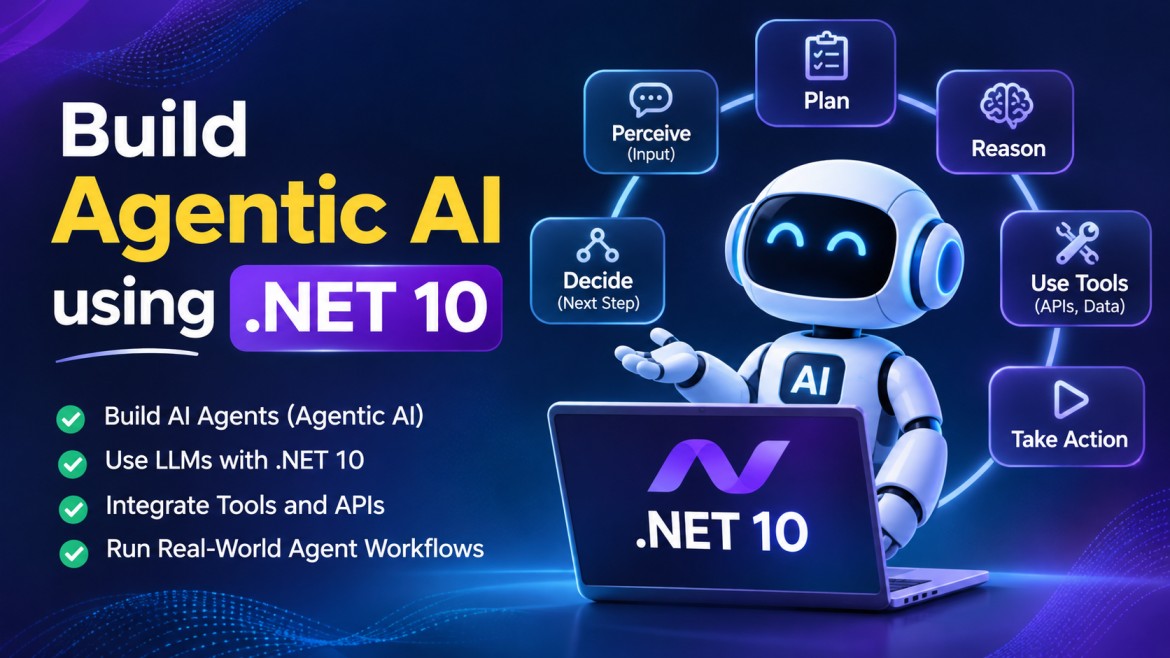
Instead of giving the system a simple question, the user can provide a goal. The agent can then determine what steps are required, call appropriate tools, examine the results, and decide what to do next. This creates a Perceive → Reason → Act loop.
For example, instead of asking, "What is the weather in Chennai?", a user could say, "Plan my outdoor event for tomorrow based on the weather." An agent could obtain weather information, analyze it, and use that information to make a recommendation.
The important difference is that the AI is now an active worker rather than just a consultant. However, it is still primarily one agent working on one goal.
Main characteristics:
Goal-oriented, uses tools, maintains state/memory, performs multiple steps, reasons and acts autonomously.
Phase 3: Agentic AI – The Collaborative Team
The next major evolution is Agentic AI. A single agent may be capable of performing many tasks, but complex business goals can require different types of expertise. Instead of creating one extremely large "god agent", we can create multiple specialized agents that collaborate.
For example, consider an e-commerce system. A customer's goal might be:
"Find a suitable laptop, check whether it is available, place the order, and arrange delivery."
This goal could involve several specialized agents. A Router Agent determines which agent should handle each part of the request. A Shopping Agent handles product selection and pricing, while an Inventory Agent checks stock and a Shipping Agent handles delivery.
The important architectural change is that the system is now a team of agents, rather than a single worker. Agents can communicate, delegate tasks, share results, and coordinate their activities to achieve the overall goal.
From Single Agent to Multi-Agent Architecture
In an AI Agent architecture, the primary challenge is making one agent capable of completing a task. In Agentic AI, the challenge becomes much broader: we need to design how multiple agents communicate, coordinate, delegate, and complete a shared objective.
A typical architecture might look like this:
                    User
                     |
              Complex Goal
                     |
               Router Agent
              /      |      \
             /       |       \
      Shopping    Inventory   Shipping
       Agent        Agent      Agent
          \          |          /
           \         |         /
            Collaboration
                  |
              Final Result
The Router Agent acts like a foreman or coordinator. It doesn't necessarily perform every task itself. Instead, it determines which specialized agent should handle each part of the overall goal.
This introduces concepts such as specialization, delegation, communication, handoffs, and orchestration. These become the central engineering concerns of Agentic AI.
The Complete Evolution
The easiest way to remember the three phases is:
| Phase | Model | Main Capability |
|---|---|---|
| Generative AI | Expert Consultant | Answers questions |
| AI Agent | Active Worker | Performs tasks |
| Agentic AI | Collaborative Team | Multiple agents work together |
The overall journey is therefore:
Generative AI
     ↓
Expert Consultant
     ↓
AI Agent
     ↓
Active Worker
     ↓
Agentic AI
     ↓
Multiple Specialized Agents
     ↓
Collaborative Autonomous System
The fundamental shift is from "AI gives me an answer" → "AI performs a task" → "AI coordinates a team to achieve a complex goal."