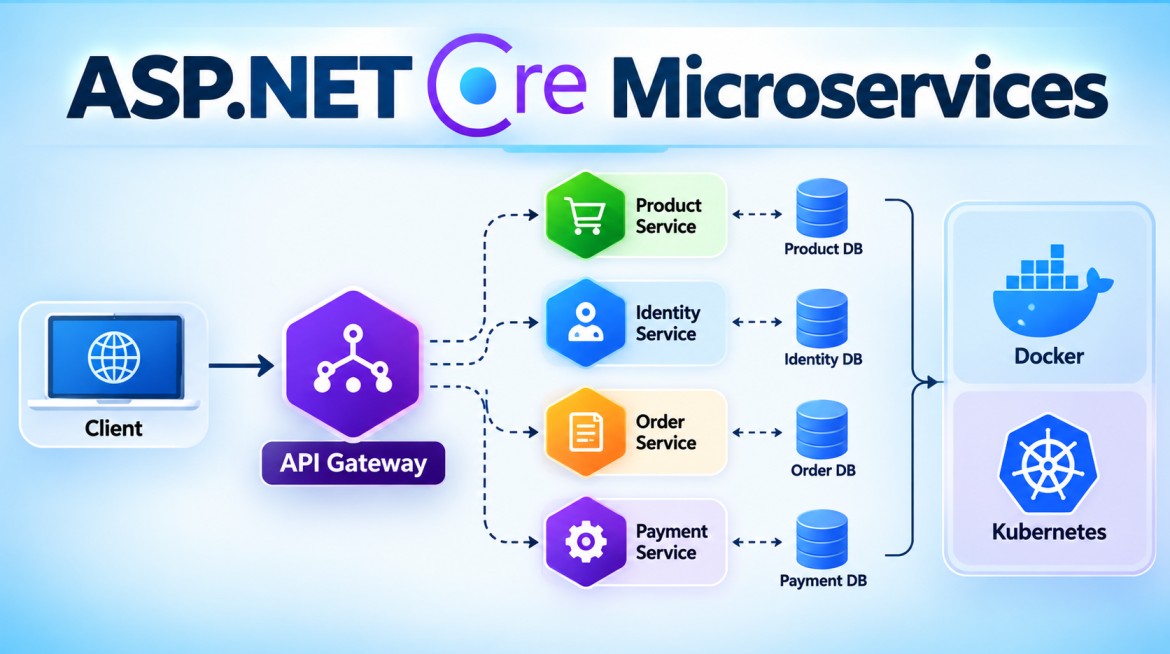


What is gRPC, and When Would You Use It Between Microservices?
1. What is gRPC?
gRPC (Google Remote Procedure Call) is a high-performance communication framework used for communication between applications or services.
In Microservices Architecture, gRPC is commonly used for service-to-service communication, especially when services need fast, strongly typed, synchronous communication.
For example:
Order Microservice
       |
       | gRPC
       ↓
Inventory Microservice
       |
       | gRPC
       ↓
Payment Microservice
Instead of exchanging typical REST/JSON messages, gRPC commonly uses:
- Protocol Buffers (Protobuf) to define contracts and serialize data
- HTTP/2 as its transport
- Generated client/server code from
.protocontracts
2. Why Do We Need gRPC?
Microservices frequently need to communicate with each other.
For example, when creating an order:
Client
   |
   ↓
Order Service
   |
   ├──→ Inventory Service
   |
   └──→ Payment Service
We could use REST:
GET /api/inventory/1001with JSON:
{
  "productId": 1001,
  "quantity": 10
}
This works well, but JSON is text-based and can create more payload and serialization overhead.
With gRPC, the contract could be:
service InventoryService {
    rpc CheckStock (StockRequest) returns (StockResponse);
}

message StockRequest {
    int32 productId = 1;
    int32 quantity = 2;
}
The client can then call something conceptually like:
var response = await inventoryClient.CheckStockAsync(request);So communication feels similar to calling a method, even though the other service may be running on another server.
3. Purpose of gRPC
The primary purpose is to provide efficient, contract-based communication between distributed services.
Order Service
      |
      | CheckStockAsync()
      |
      | Protobuf over HTTP/2
      ↓
Inventory Service
      |
      ↓
StockResponse
It is particularly useful for internal Microservice communication where performance and strict contracts are important.
4. How gRPC Works
Step 1 — Define a .proto contract
syntax = "proto3";

service ProductService {

    rpc GetProduct (ProductRequest)
        returns (ProductResponse);
}

message ProductRequest {
    int32 id = 1;
}

message ProductResponse {
    int32 id = 1;
    string name = 2;
    double price = 3;
}
The .proto file defines:
- Service
- Methods
- Request structure
- Response structure
Step 2 — Generate client/server classes
The gRPC tooling generates strongly typed classes for your language/platform.
For example:
ProductService.ProductServiceClientStep 3 — Microservice calls another Microservice
var response = await client.GetProductAsync(
    new ProductRequest
    {
        Id = 1001
    });
Step 4 — gRPC serializes the request
Protobuf converts the request into a compact binary representation.
C# Object
    ↓
Protocol Buffers
    ↓
Binary Data
    ↓
HTTP/2
    ↓
Product Microservice
The receiving service deserializes the message and executes the corresponding method.
5. When Would You Use gRPC Between Microservices?
gRPC is a strong choice when you need fast internal service-to-service communication.
Example
Suppose you have:
E-Commerce System

API Gateway
     |
     ↓
Order Service
     |
     ├──── gRPC ───→ Product Service
     |
     ├──── gRPC ───→ Inventory Service
     |
     └──── gRPC ───→ Pricing Service
The public-facing API might use:
Browser
   ↓
REST / JSON
   ↓
API Gateway
while internal communication uses:
Order Service
   ↓
gRPC
   ↓
Inventory Service
This combination is common because browsers and external consumers often benefit from REST/JSON's accessibility, while internal services can benefit from gRPC's compact contracts and streaming capabilities.
6. Advantages of gRPC
1. High Performance
Protocol Buffers use a compact binary representation.
REST
JSON → Text

gRPC
Protobuf → Binary
This can reduce serialization and network overhead.
2. Strongly Typed Contracts
The .proto file explicitly defines the contract.
rpc GetProduct(ProductRequest)
    returns(ProductResponse);
This reduces ambiguity between services.
3. HTTP/2
gRPC uses HTTP/2, providing capabilities such as:
- Multiplexing
- Efficient connection reuse
- Header compression
- Streaming
4. Automatic Code Generation
From the .proto contract, tooling can generate client/server types.
Instead of manually building HTTP requests:
await httpClient.GetAsync(...);you can work with a generated client:
await productClient.GetProductAsync(...);5. Streaming Support
gRPC supports four communication patterns:
1. Unary
   Request → Response

2. Server Streaming
   Request → Multiple Responses

3. Client Streaming
   Multiple Requests → Response

4. Bidirectional Streaming
   Multiple Requests ↔ Multiple Responses
This is one of gRPC's major capabilities.
6. Cross-Platform
A service written in ASP.NET Core can communicate with services implemented in other supported languages using the same Protobuf contract.
For example:
.NET Service
     |
     | gRPC
     ↓
Java Service
     |
     | gRPC
     ↓
Go Service
7. Disadvantages of gRPC
1. Less Human-Readable
REST JSON:
{
    "id": 101,
    "name": "Laptop"
}
is easy to inspect.
Protobuf is normally transmitted as binary, making raw network messages less convenient to inspect manually.
2. Browser Usage Requires Additional Consideration
Native gRPC relies on HTTP/2 features that browser JavaScript does not expose in the same way as native gRPC clients.
For browser scenarios, technologies such as gRPC-Web may be required.
3. More Contract Management
You need to maintain .proto files carefully.
product.proto
order.proto
inventory.proto
Schema evolution and backward compatibility become important as services change.
4. Not Always Ideal for Public APIs
For APIs intended for many external consumers, REST/JSON can be simpler because of its broad tooling, debuggability, and accessibility.
8. REST vs gRPC
| Feature | REST | gRPC |
|---|---|---|
| Typical format | JSON | Protobuf |
| Transport | HTTP/1.1 or HTTP/2+ | HTTP/2 |
| Data | Usually text | Binary |
| Contract | Often OpenAPI | .proto |
| Code generation | Optional | Core workflow |
| Streaming | Possible, varies | Built-in |
| Browser friendliness | Excellent | More limited |
| Internal Microservices | Good | Excellent fit |
| Public APIs | Common | Depends on clients |
| Performance | Good | Often lower overhead |
A useful architectural pattern is:
External Clients
      |
   REST/JSON
      |
      ↓
 API Gateway
      |
      ↓
Order Service
      |
      | gRPC
      ↓
Inventory Service
9. Key Points
- gRPC = Remote Procedure Call framework.
- It is widely used for service-to-service communication.
- It commonly uses Protocol Buffers for contracts and serialization.
- It uses HTTP/2.
.protofiles define service contracts.- Client and server code can be generated automatically.
- It supports unary and streaming communication.
- It is particularly useful when performance, low payload overhead, streaming, and strongly typed contracts matter.
- REST remains a strong option for public-facing APIs and simpler interoperability requirements.
- gRPC is synchronous request/response communication in the common unary case; it is not a replacement for asynchronous messaging systems such as RabbitMQ, Azure Service Bus, or Kafka.
10. Interview Questions and Answers
Q1. What is gRPC?
Answer:
gRPC is a high-performance RPC framework commonly used for communication between distributed services. It uses Protocol Buffers for strongly typed contracts and commonly runs over HTTP/2.
Q2. Why is gRPC used in Microservices?
Answer:
It is used for efficient service-to-service communication where low overhead, strong contracts, code generation, or streaming capabilities are important.
Q3. What is Protocol Buffers?
Answer:
Protocol Buffers, or Protobuf, is a language-neutral mechanism for defining structured messages and serializing them into a compact binary representation.
Q4. REST or gRPC — which should we use?
Answer:
It depends on the requirement. REST is often convenient for public APIs and browser clients, while gRPC is especially useful for high-performance internal Microservice communication and streaming.
Q5. Does gRPC support asynchronous communication?
Answer:
gRPC APIs can be called asynchronously at the programming level, such as using await, but that is different from message-based asynchronous communication.
gRPC:
Service A → Request → Service B
          ← Response ←

Messaging:
Service A → Message Broker → Service B
For event-driven, decoupled communication, technologies such as RabbitMQ, Kafka, or Azure Service Bus are generally more appropriate.
Q6. What communication types does gRPC support?
Answer:
- Unary
- Server streaming
- Client streaming
- Bidirectional streaming
Q7. When would you use gRPC between Microservices?
Answer:
I would consider gRPC when Microservices require high-performance synchronous communication, strongly typed contracts, efficient payloads, or streaming, particularly for internal service-to-service calls.
Interview-ready answer
gRPC is a high-performance RPC framework used for service-to-service communication. It uses Protocol Buffers to define strongly typed contracts and typically communicates over HTTP/2. In Microservices, I would use gRPC when internal services need efficient, low-latency communication or streaming. For public/browser APIs, I may prefer REST, while for event-driven asynchronous communication I would use a message broker such as RabbitMQ, Kafka, or Azure Service Bus.