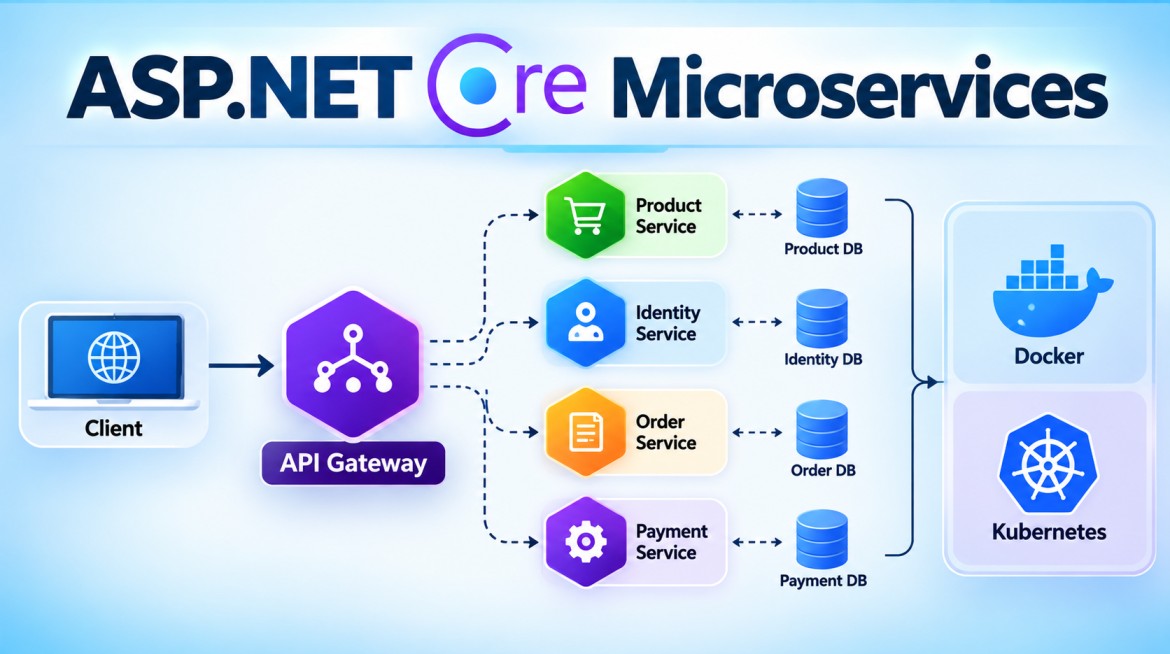


How Do You Design a Microservice to Be Independently Deployable?
An independently deployable microservice can be built, tested, versioned, deployed, scaled, and rolled back without requiring other microservices to be deployed at the same time.
For example:
Product Service v1
Order Service   v1
Payment Service v1
        ↓
Deploy only Payment Service
        ↓
Product Service v1
Order Service   v1
Payment Service v2
This is one of the core characteristics of Microservices Architecture.
1. What Does Independently Deployable Mean?
Suppose the Payment Service requires a new payment provider.
Tightly coupled system
Payment Change
      ↓
Update Order Service
      ↓
Update Payment Service
      ↓
Deploy Both Services
This is not truly independent.
Better design
Payment Service
      ↓
Internal Change
      ↓
Deploy Payment Service v2

Order Service → No deployment required
As long as the existing contract remains compatible, other services continue working.
2. Why Do We Need Independent Deployment?
Imagine a system with:
Product Service
Order Service
Payment Service
Inventory Service
Shipping Service
Notification Service
If every Payment change requires all six services to be deployed, we have lost an important benefit of microservices.
Independent deployment provides:
- Faster releases
- Smaller deployment scope
- Reduced coordination between teams
- Independent rollback
- Independent scaling
- Reduced release risk
3. Define Clear Business Boundaries
First, each service should have a clear business responsibility.
For example:
Order Service
 ├── Create Order
 ├── Order Items
 ├── Order Status
 └── Order History

Payment Service
 ├── Process Payment
 ├── Payment Status
 └── Refund
Avoid mixing responsibilities across services.
Good boundaries based on business capabilities / bounded contexts are the foundation for independent deployment.
4. Avoid Shared Code That Forces Coordinated Releases
Be careful with shared libraries.
For example:
           Shared.Domain.dll
             /        \
            ↓          ↓
      Order Service  Payment Service
If every business-model change in Shared.Domain.dll requires both services to upgrade together, the services become coupled.
Shared libraries are reasonable for stable technical concerns such as:
Logging helpers
Telemetry
Common infrastructure utilities
But avoid sharing large business/domain models between independently deployed services.
Share stable technical capabilities carefully; don't create a shared business model that couples all services together.
5. Each Service Should Own Its Data
Avoid:
Order Service ────┐
                  ├──→ Shared Orders/Payments Tables
Payment Service ──┘
A schema change could force multiple services to change simultaneously.
Prefer:
Order Service
      ↓
Order DB


Payment Service
      ↓
Payment DB
Then communicate through:
REST
gRPC
Events / Messages
Clear data ownership allows database schema changes to remain mostly internal to the owning service.
6. Use Stable API Contracts
Suppose Order Service calls:
GET /api/payments/100Payment Service should avoid making breaking changes without a migration strategy.
For example, changing:
{
  "paymentId": 100,
  "status": "Completed"
}
to something completely incompatible could break Order Service.
Prefer backward-compatible changes whenever possible.
For example, adding an optional field:
{
  "paymentId": 100,
  "status": "Completed",
  "transactionReference": "TX123"
}
Older consumers can often continue working.
7. Use API Versioning When Necessary
If a breaking contract change is unavoidable, support controlled versioning.
Order Service
      ↓
Payment API v1

New Consumer
      ↓
Payment API v2
For example:
/api/v1/payments/100

/api/v2/payments/100
This gives consumers time to migrate rather than forcing simultaneous deployment.
8. Design Events for Compatibility
The same principle applies to asynchronous communication.
Suppose Payment Service publishes:
PaymentCompletedConsumers may include:
PaymentCompleted
      |
      ├──→ Order Service
      ├──→ Notification Service
      └──→ Reporting Service
Changing the event unexpectedly can break several consumers.
Therefore:
- Keep event contracts stable.
- Prefer additive changes.
- Version events when necessary.
- Don't expose internal database entities directly as integration events.
9. Externalize Configuration
A service should not require code changes when moving between environments.
Avoid:
var paymentUrl =
    "https://uat-payment-server";
Use configuration:
{
  "PaymentService": {
    "BaseUrl": "..."
  }
}
Then override using:
Environment Variables
Azure App Configuration
Kubernetes ConfigMaps
Secret Store
The same application artifact can move through:
Development
    ↓
SIT
    ↓
UAT
    ↓
Production
10. Separate Secrets
Secrets should not be packaged directly into the application.
Application
    ↓
External Configuration
    +
Secret Store
For Azure environments:
Microservice
    ↓
Managed Identity
    ↓
Azure Key Vault
This allows the service to be deployed independently without embedding environment-specific credentials.
11. Independent CI/CD Pipeline
Each microservice should ideally have its own deployment pipeline.
Product Repository
      ↓
Product CI/CD
      ↓
Product Deployment


Order Repository
      ↓
Order CI/CD
      ↓
Order Deployment


Payment Repository
      ↓
Payment CI/CD
      ↓
Payment Deployment
Changing Payment Service should trigger:
Payment Change
     ↓
Build
     ↓
Unit Test
     ↓
Integration Test
     ↓
Package
     ↓
Deploy Payment
It should not automatically require Product and Order Service deployments.
12. Package the Service Independently
Containers are commonly used for this.
Payment Service
      ↓
Docker Image
      ↓
payment-service:2.0
For example:
product-service:1.5
order-service:3.1
payment-service:2.0
Each service can have its own version and deployment lifecycle.
Docker helps independent deployment, but Docker itself is not mandatory for microservices.
13. Avoid Runtime Dependency Chains Where Possible
Independent deployment doesn't mean a service has zero dependencies.
For example:
Order Service
      ↓
Payment Service
But the Order Service should handle failures properly.
Use techniques such as:
Timeout
Retry
Circuit Breaker
Bulkhead
Fallback
Asynchronous Messaging
Otherwise, one unavailable service can cause cascading failures.
14. Use Asynchronous Communication Where Appropriate
Strong synchronous dependency chains can increase coupling:
Order
  ↓
Payment
  ↓
Inventory
  ↓
Shipping
  ↓
Notification
One failure can affect the entire request.
For suitable operations, events can reduce temporal coupling:
Order Service
      ↓
OrderCreated
      ↓
Message Broker
   ┌──────┼─────────┐
   ↓      ↓         ↓
Payment Inventory Notification
Consumers can process the event independently.
This does not mean every interaction should be asynchronous. Choose based on business consistency and response requirements.
15. Database Migration Must Also Be Safe
Independent deployment includes database changes.
Suppose Payment Service changes its schema.
Avoid requiring:
Stop Payment Service
      ↓
Change Database
      ↓
Deploy New Version
when possible.
Use backward-compatible database migrations.
A common approach is:
Expand
  ↓
Deploy
  ↓
Migrate
  ↓
Contract
For example:
- Add a new nullable column.
- Deploy code that supports old and new structures.
- Migrate existing data.
- Update consumers/code.
- Remove the old column later.
This reduces deployment coupling and downtime.
16. Health Checks
A deployed service should expose health information.
ASP.NET Core:
builder.Services.AddHealthChecks();

app.MapHealthChecks("/health");
Infrastructure can determine:
Payment Service
      ↓
/health
      ↓
Healthy / Unhealthy
This helps load balancers and orchestration platforms determine whether an instance should receive traffic.
17. Observability
Independent services also need independent monitoring.
Each service should provide:
Logs
Metrics
Distributed Traces
Health Checks
For example:
Request
   ↓
API Gateway
   ↓
Order Service
   ↓
Payment Service

TraceId: ABC123
Tools such as OpenTelemetry can help trace requests across services.
18. Independent Rollback
Suppose:
Payment Service v1
       ↓
Deploy v2
       ↓
Problem detected
You should be able to:
Payment Service v2
       ↓
Rollback
       ↓
Payment Service v1
without rolling back Product, Order, and Inventory services.
This requires compatible APIs, events, and database changes.
19. Deployment Strategies
Production environments may use strategies such as:
Rolling Deployment
v1 v1 v1
    ↓
v2 v1 v1
    ↓
v2 v2 v1
    ↓
v2 v2 v2
Blue-Green Deployment
Blue  → Current version
Green → New version

Test Green
    ↓
Switch Traffic
    ↓
Green becomes active
Canary Deployment
v1 → 95% Traffic
v2 →  5% Traffic

        ↓

Gradually increase v2
These approaches can reduce deployment risk.
20. Advantages
Designing microservices for independent deployment provides:
- Faster releases
- Smaller deployment scope
- Independent rollback
- Reduced team coordination
- Independent scaling
- Better fault isolation
- Easier service evolution
- Different release schedules
- Lower impact from individual changes
21. Disadvantages / Challenges
Independent deployment requires discipline:
- API compatibility must be maintained.
- Event contracts must be managed.
- Database migrations become more important.
- CI/CD becomes more complex.
- More deployments must be monitored.
- Distributed testing is harder.
- Version management becomes important.
- Observability infrastructure is required.
22. Key Points
To make a microservice independently deployable:
Clear Business Boundary
          ↓
Own Business Logic
          ↓
Own Data
          ↓
Stable API/Event Contracts
          ↓
Backward Compatibility
          ↓
External Configuration
          ↓
Independent CI/CD
          ↓
Independent Package/Container
          ↓
Safe Database Migration
          ↓
Health Checks + Observability
          ↓
Independent Deployment
Remember:
- Define services around business capabilities.
- Avoid shared database tables.
- Avoid tightly coupled shared business libraries.
- Maintain backward-compatible APIs and events.
- Version contracts when breaking changes are unavoidable.
- Externalize configuration and secrets.
- Give each service its own build/deployment lifecycle.
- Use safe database migrations.
- Design for service failures.
- Support independent rollback.
- Independent deployment does not mean zero communication between services.
23. Interview Questions & Answers
Q1. How do you design a microservice to be independently deployable?
I give the service a clear business boundary and data ownership, maintain backward-compatible API/event contracts, externalize configuration, provide an independent CI/CD pipeline, and ensure its database migrations and rollback strategy don't require coordinated deployment with other services.
Q2. Does independent deployment mean microservices cannot depend on each other?
No. Services can communicate, but their contracts should allow one service to evolve without requiring simultaneous deployment of its consumers.
Q3. Why is database ownership important?
If multiple services directly depend on the same database schema, a schema change can require coordinated changes and deployments.
Clear data ownership reduces this coupling.
Q4. Why is backward compatibility important?
Suppose:
Order Service → Payment ServiceIf Payment Service changes its API but Order Service hasn't been deployed yet, the old Order Service must still be able to communicate with it during the migration period.
Q5. Should each microservice have its own CI/CD pipeline?
Ideally, each independently deployable service should have an independent build and deployment lifecycle, even if pipeline templates or infrastructure are shared.
Q6. How do you handle breaking API changes?
Prefer backward-compatible changes first. When a breaking change is necessary, use techniques such as API versioning and gradual consumer migration.
Q7. How do you handle database changes during independent deployment?
Use backward-compatible migration strategies such as Expand-and-Contract, allowing old and new application versions to work during the transition.
Q8. Does Docker make a service independently deployable?
Docker helps package and deploy services independently, but containerization alone doesn't guarantee independence. The API, database, configuration, and service dependencies must also be properly designed.
Interview One-Line Answer
Design a microservice for independent deployment by giving it clear business and data ownership, stable backward-compatible contracts, external configuration, an independent CI/CD lifecycle, safe database migrations, resilience, observability, and the ability to deploy or roll back without requiring simultaneous changes to other services.