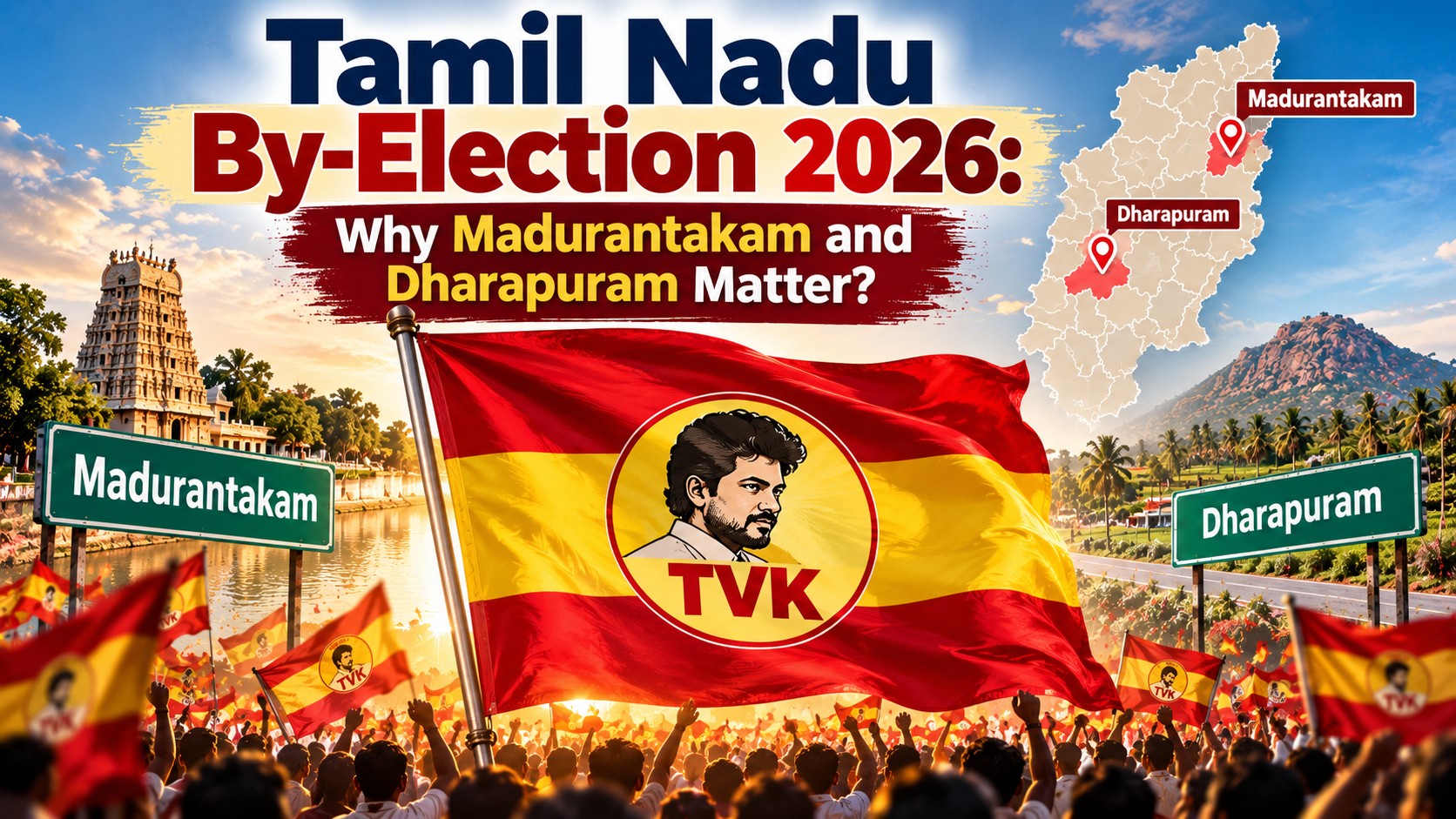


Tamil Nadu By-Election 2026: Why Madurantakam and Dharapuram Matter
Tamil Nadu's first major electoral test after the 2026 Assembly election concluded on October 6, with voters in Madurantakam and Dharapuram casting their ballots in two closely watched by-elections.
The results will be declared on October 9, 2026. Although only two Assembly seats are involved, the political significance extends well beyond the constituencies themselves. The contests are being watched as an early test of Chief Minister C. Joseph Vijay's Tamilaga Vettri Kazhagam (TVK) government and as an important opportunity for the DMK and AIADMK to demonstrate their continuing electoral strength.
Why Were These By-Elections Necessary?
Both Madurantakam and Dharapuram are Scheduled Caste-reserved constituencies.
In the April 2026 Assembly election, both seats were won by AIADMK candidates.
In Madurantakam, K. Maragatham Kumaravel won as the AIADMK candidate. In Dharapuram, P. Sathyabama won for the AIADMK.
Both subsequently resigned their Assembly seats, left the AIADMK and joined the ruling TVK. They are now contesting the same constituencies again, but this time as TVK candidates.
This creates an unusual political question:
Did voters support the candidates personally in April, or did they primarily vote for the AIADMK?
The October 9 results may provide an answer.
Madurantakam: A Very Close Three-Way History
Madurantakam was already extremely competitive in the April Assembly election.
The approximate result was:
-
AIADMK – K. Maragatham Kumaravel: 69,284 votes
-
TVK: 62,090 votes
-
DMK: 59,838 votes
Maragatham therefore won by only 7,194 votes. TVK and DMK were both relatively close behind.
The political equation has now changed considerably.
Maragatham is no longer representing AIADMK. She is contesting for TVK.
The principal candidates in the by-election include:
-
TVK: K. Maragatham Kumaravel
-
DMK: I. Paranthamen
-
AIADMK: S. Kanitha Sampath
-
CPI(M): P. Suganthi
-
NTK: G. Janakiraman
A total of 27 candidates contested the constituency.
What Makes Madurantakam Interesting?
The April result suggests three substantial vote bases were already present: AIADMK, TVK and DMK.
Now the previous AIADMK winner herself represents TVK.
The central question is therefore how the 69,284 votes Maragatham received while contesting for AIADMK in April have redistributed.
If a meaningful portion followed Maragatham personally to TVK while TVK retained much of its own April support, TVK could substantially strengthen its position.
If most previous AIADMK voters remained loyal to the party rather than the candidate, AIADMK could remain highly competitive.
DMK, meanwhile, started from a substantial base of nearly 60,000 votes in April. A division of the previous AIADMK vote between TVK and AIADMK could therefore also create an opportunity for DMK.
That makes Madurantakam particularly difficult to interpret before votes are actually counted.
Dharapuram: A Different Electoral Equation
Dharapuram presents a somewhat different picture.
In April 2026:
-
AIADMK – P. Sathyabama: 81,100 votes
-
DMK: 64,373 votes
-
TVK: 46,438 votes
Sathyabama won by 16,727 votes, while TVK finished third.
Now Sathyabama herself is contesting for TVK.
The principal candidates include:
-
TVK: P. Sathyabama
-
DMK: S. Suganya
-
AIADMK: K. Banumathi
-
NTK: M. Karthika
-
CPI: P. Lakshmanan
This makes Dharapuram especially significant for TVK.
Unlike Madurantakam, where TVK was already a close second in April, TVK was third in Dharapuram.
The result will therefore indicate how much of Sathyabama's previous electoral support was attached to her personally and how much belonged to AIADMK.
Voter Turnout: High, But Lower Than April
Voting remained substantial in both constituencies, although participation fell compared with the April Assembly election.
Post-poll reports put Madurantakam at roughly 86% turnout and Dharapuram at roughly 80%. Reports noted that both were lower than their corresponding April turnout levels.
Lower turnout by itself does not tell us which party benefited.
The important question is which groups of voters were less likely to return to the polling booths.
That will become clearer only when booth-level voting patterns and final results are available.
Who Will Win?
There is currently no reliable published exit poll for the Madurantakam and Dharapuram by-elections. Counting begins on October 9, so declaring a winner based only on turnout or campaign crowds would be speculation.
Instead, there are several measurable factors worth watching.
Madurantakam
The key issue is the redistribution of the April AIADMK vote.
Maragatham previously received 69,284 votes as an AIADMK candidate, while TVK itself received 62,090.
If significant numbers of her former voters followed her to TVK, combining that movement with TVK's existing support could materially change the constituency.
But AIADMK is contesting independently again, while DMK entered the by-election with an April base of 59,838 votes.
Therefore, the result could depend heavily on how the former AIADMK vote splits among TVK, AIADMK and other alternatives, and whether DMK expands or consolidates its previous support.
Dharapuram
Dharapuram poses an even more interesting transfer question.
Sathyabama received 81,100 votes for AIADMK in April, while TVK received only 46,438.
For TVK, the central issue is whether Sathyabama can bring a substantial portion of her previous voters with her.
For AIADMK, the question is whether voters who supported Sathyabama in April primarily supported the party symbol and organisation, rather than the individual candidate.
DMK, which received 64,373 votes in April, has its own established electoral base and could benefit if the previous AIADMK vote becomes fragmented.
Why These Two Results Matter to TVK
These are the first by-elections since Vijay's government came to power.
That gives them significance beyond adding two MLAs.
The results will provide an early indication of whether TVK has been able to retain or expand its support after taking office.
They will also test something important about party-switching: whether established politicians who move from one party to another can bring their voters with them.
Chief Minister Vijay campaigned intensively in the constituencies, further increasing the political importance attached to the contests.
Why They Matter to AIADMK
For AIADMK, the circumstances are unusual.
The party won both constituencies only months ago, but the MLAs who delivered those victories subsequently resigned and joined TVK.
AIADMK is therefore effectively asking voters to choose the party again with different candidates.
A strong AIADMK performance would indicate that a substantial part of its April support remained with the party despite the defections.
Conversely, a significant movement of votes toward the former MLAs would suggest that candidate loyalty played an important role.
Why They Matter to DMK
DMK did not win either constituency in April, but it already had substantial support in both.
That means DMK does not necessarily need every former AIADMK voter to switch directly to it.
In a multi-cornered contest, the fragmentation of another party's previous vote can alter the winning threshold.
The DMK's performance will therefore indicate whether it has been able to consolidate opposition votes and expand its April support during the first months of the new political environment.
Five Things to Watch on Counting Day
When counting begins on October 9, five numbers will be particularly revealing:
-
TVK's vote share compared with April
-
AIADMK's retained vote share after losing its two sitting MLAs
-
DMK's change in vote share
-
How the lower turnout affected the major parties
-
The final winning margins compared with April
The first few counting rounds may produce changing leads, so early trends should not automatically be treated as the final result.
More Than Just Two Assembly Seats
On paper, these are by-elections for only two constituencies.
Politically, however, they ask much larger questions.
Can TVK convert the popularity that brought it to power into sustained electoral support?
Can AIADMK demonstrate that its voters remain loyal to the party even when elected representatives defect?
Can DMK take advantage of a changing political landscape and expand its support?
And perhaps most interestingly:
When an elected MLA changes parties, do the voters follow the candidate — or stay with the party?
Madurantakam and Dharapuram provide an unusually direct test of that question.
The voters have already made their decision.
On October 9, 2026, the counting of votes will reveal the answer.