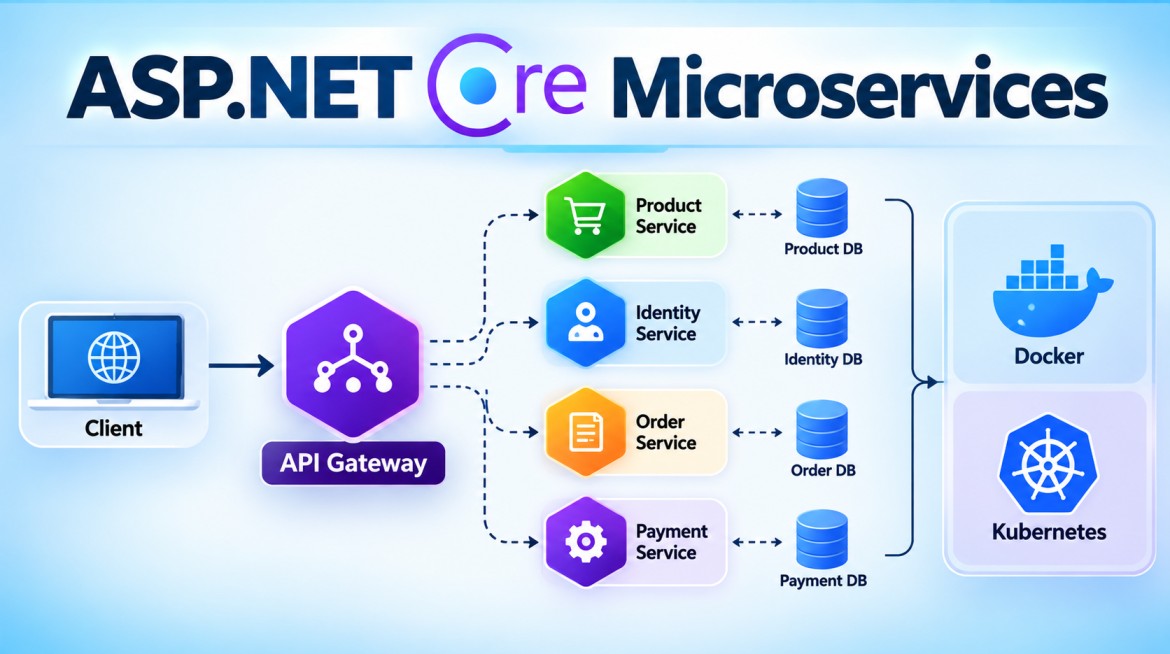


How Do Microservices Communicate with Each Other?
1. What is Microservice Communication?
In a Microservices Architecture, an application is divided into multiple independent services.
For example, an e-commerce system may contain:
Order Service
Product Service
Payment Service
Inventory Service
Notification Service
These services often need information or actions from one another. The mechanism they use to exchange requests, responses, events, or messages is called microservice communication.
There are two major communication styles:
1. Synchronous Communication
2. Asynchronous Communication
2. Why Do We Need It?
Although microservices are independently developed and deployed, they still need to work together to complete a business operation.
For example, when a customer places an order:
Customer
   │
   ▼
Order Service
   │
   ├──► Inventory Service
   │
   ├──► Payment Service
   │
   └──► Notification Service
The Order Service cannot perform everything itself. It may need other services to check inventory, process payment, and send notifications.
Therefore, communication mechanisms allow independent services to collaborate without combining them into one application.
3. Purpose
The main purpose is to allow microservices to:
- Exchange data
- Request operations from other services
- Notify other services about business events
- Coordinate business workflows
- Remain independently deployable
- Reduce direct dependencies where possible
4. Synchronous Communication
In synchronous communication, one service sends a request to another service and waits for the response.
Common technologies include:
- REST APIs using HTTP/HTTPS
- gRPC
Example
Suppose the Order Service needs product information.
Order Service
     │
     │ HTTP GET
     ▼
Product Service
     │
     │ Response
     ▼
Order Service
Example request:
GET /api/products/101Response:
{
  "id": 101,
  "name": "Laptop",
  "price": 75000
}
In ASP.NET Core, one service can call another using HttpClient:
var product = await httpClient
    .GetFromJsonAsync<ProductDto>("api/products/101");
The Order Service waits until Product Service responds.
Advantages
- Simple to understand
- Easy to implement
- Immediate response
- Suitable when the caller needs the result immediately
- REST APIs are widely supported
Disadvantages
- Caller depends on the other service being available
- Network latency affects the caller
- Failures can propagate between services
- Long chains of synchronous calls can reduce reliability
- Can create tighter runtime coupling
For example:
Order
  ↓
Inventory
  ↓
Payment
  ↓
Shipping
If Payment Service is unavailable, the entire request may fail unless resilience mechanisms are implemented.
5. Asynchronous Communication
In asynchronous communication, the sender publishes a message or event and normally does not wait for the receiving service to finish processing it.
A message broker is commonly used.
Examples include:
- RabbitMQ
- Apache Kafka
- Azure Service Bus
- AWS SQS/SNS
Example:
Order Service
      │
      │ OrderCreated
      ▼
 Message Broker
   │        │
   ▼        ▼
Inventory  Notification
Service     Service
Order Service might publish:
{
  "event": "OrderCreated",
  "orderId": 5001,
  "customerId": 100
}
Interested services consume the event independently.
Advantages
- Loose coupling
- Better scalability
- Better fault isolation
- Sender does not have to wait
- Useful for event-driven architectures
- Multiple services can react to the same event
Disadvantages
- More complex architecture
- Requires message-broker infrastructure
- Debugging is harder
- Eventual consistency may need to be handled
- Duplicate messages may occur
- Requires retry, idempotency, dead-letter handling, and monitoring strategies
6. Synchronous vs Asynchronous
| Feature | Synchronous | Asynchronous |
|---|---|---|
| Communication | Request/Response | Message/Event |
| Caller waits | Yes | Usually no |
| Common technologies | REST, gRPC | RabbitMQ, Kafka, Azure Service Bus |
| Coupling | Higher runtime coupling | Lower runtime coupling |
| Immediate response | Yes | Usually no |
| Failure isolation | Lower | Better |
| Complexity | Lower | Higher |
| Typical use | Immediate data/action | Events/background processing |
7. Which One Should We Use?
Real-world microservice systems commonly use both.
Use synchronous communication when the caller immediately needs a result.
Order Service
      │
      │ "Is product available?"
      ▼
Inventory Service
      │
      │ Yes / No
      ▼
Order Service
Use asynchronous communication when another service only needs to be informed that something happened.
Order Service
      │
      │ OrderCreated
      ▼
Message Broker
      │
      ├──► Notification Service
      ├──► Analytics Service
      └──► Shipping Service
A useful design principle is:
Use synchronous calls when an immediate response is required; use asynchronous messaging when services can react independently to an event.
8. Key Points
- Microservices communicate mainly through synchronous APIs or asynchronous messaging.
- REST and gRPC are common synchronous approaches.
- Message brokers support asynchronous communication.
- Avoid unnecessary chains of service-to-service HTTP calls.
- Asynchronous messaging helps reduce runtime coupling.
- Distributed communication can fail, so production systems should consider timeouts, retries, circuit breakers, idempotency, and observability.
- Microservices should communicate through well-defined API or message contracts, rather than directly accessing another service's database.
- Many production architectures combine REST/gRPC with event-driven messaging.
9. Interview Questions and Answers
Q1. How do microservices communicate with each other?
Answer:
Microservices mainly communicate using synchronous communication, such as REST or gRPC, and asynchronous communication, such as RabbitMQ, Kafka, or Azure Service Bus.
Q2. What is synchronous communication?
Answer:
The calling service sends a request to another service and waits for its response. REST APIs and gRPC are common examples.
Q3. What is asynchronous communication?
Answer:
The service sends a message or publishes an event through a message broker, and the receiving service processes it independently.
Q4. Which is better: synchronous or asynchronous?
Answer:
Neither is universally better. Use synchronous communication when an immediate response is required and asynchronous communication when services can process events independently.
Q5. Can we use both in the same application?
Answer:
Yes. This is very common. For example, an Order Service might synchronously call Inventory Service but asynchronously publish an OrderCreated event for Notification and Analytics services.
Q6. Should one microservice directly access another microservice's database?
Answer:
Generally, no. A service should own its data and expose it through an API or messaging contract. Direct database sharing increases coupling and weakens service independence.