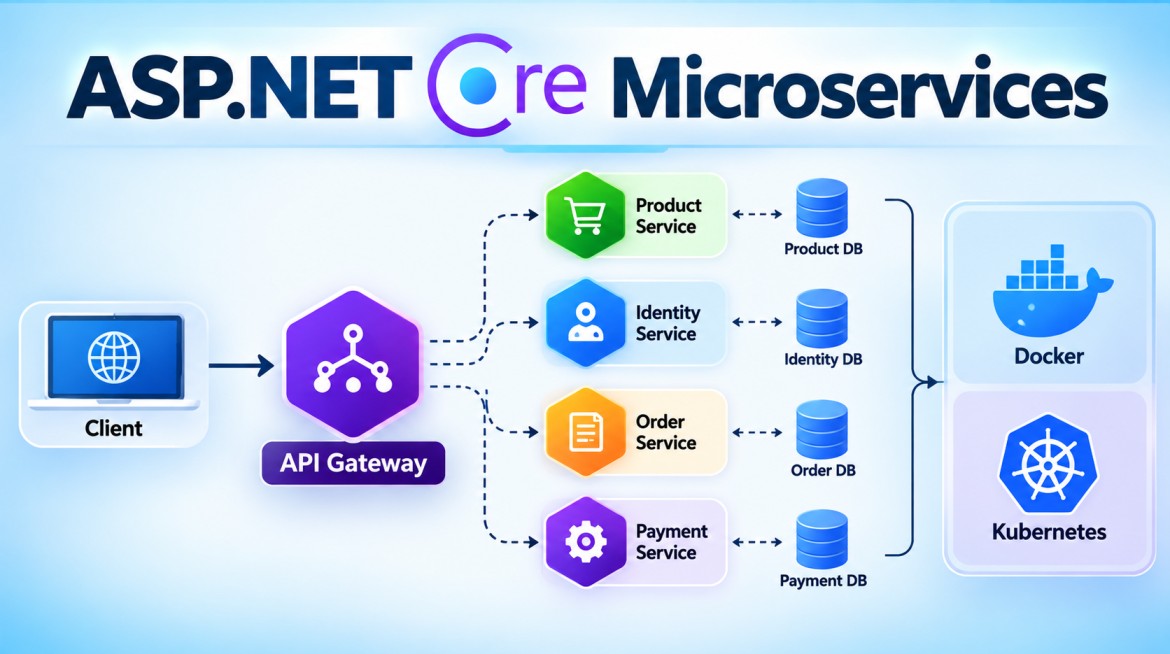


1. How Does Load Balancing Work with Microservices?
What is Load Balancing?
Load balancing is the process of distributing incoming requests across multiple instances of the same microservice.
Suppose ProductService has three instances:
ProductService

Instance 1 → 10.0.1.11
Instance 2 → 10.0.1.12
Instance 3 → 10.0.1.13
If 3,000 requests arrive, we don't want all requests going to Instance 1.
Instead:
                    Load Balancer
                         |
             +-----------+-----------+
             |           |           |
             v           v           v
         Product-1   Product-2   Product-3
The load balancer distributes requests among the healthy, eligible instances.
Why Do We Need Load Balancing?
Microservices are commonly deployed with multiple instances for:
- scalability
- high availability
- fault tolerance
- rolling deployments
- handling traffic spikes
- avoiding a single overloaded instance
Without load balancing:
                1,000 Requests
                      |
                      v
                 Product-1
                  OVERLOAD
while:
Product-2 → Idle
Product-3 → Idle
With load balancing:
                1,000 Requests
                      |
                Load Balancer
                      |
          +-----------+-----------+
          |           |           |
          v           v           v
       Product-1   Product-2   Product-3
The workload can be distributed across the available instances.
Purpose
The major purposes are:
- Traffic distribution
- Scalability
- High availability
- Fault tolerance
- Health-aware routing
- Supporting horizontal scaling
Vertical Scaling vs Horizontal Scaling
Load balancing becomes particularly important with horizontal scaling.
Vertical Scaling
Increase the resources of one server:
Before
4 CPU
8 GB RAM

       ↓

After
16 CPU
32 GB RAM
Horizontal Scaling
Add more instances:
Before

Product-1

After

Product-1
Product-2
Product-3
Product-4
Load balancing distributes traffic across those instances.
Basic Microservices Architecture
Suppose we have:
Product Service
Order Service
Payment Service
Each has multiple instances:
                     Client
                       |
                       v
                  API Gateway
                       |
          +------------+------------+
          |            |            |
          v            v            v
       Product       Order        Payment
         LB            LB            LB
       / | \          / | \          / \
      P1 P2 P3       O1 O2 O3       M1 M2
The gateway determines which service should receive the request.
Load balancing determines which instance of that service should receive it.
That distinction is important.
Example
Client sends:
GET /products/100API Gateway determines:
/products/* → ProductServiceProductService has:
P1
P2
P3
The load-balancing layer selects:
P2Final flow:
Client
   ↓
API Gateway
   ↓
Product Service
   ↓
Load Balancing
   ↓
P2
How Does the Load Balancer Know the Instances?
This is where Service Discovery becomes important.
Suppose the registry/platform knows:
ProductService

P1 → 10.0.1.11
P2 → 10.0.1.12
P3 → 10.0.1.13
The routing/load-balancing infrastructure uses this information to identify available backends.
Conceptually:
Service Discovery
       |
       | Available Product instances
       v
Load Balancer
       |
       | Select one
       v
Product Instance
Without dynamic discovery, the load balancer would need some other mechanism or static configuration to know where the instances are.
Common Load-Balancing Algorithms
1. Round Robin
Requests are distributed sequentially.
Request 1 → P1
Request 2 → P2
Request 3 → P3
Request 4 → P1
Request 5 → P2
Request 6 → P3
Simple and commonly understood.
2. Random
An available instance is selected randomly.
Request 1 → P3
Request 2 → P1
Request 3 → P3
Request 4 → P2
3. Least Connections
Send the new request/connection to the instance with fewer active connections.
Example:
P1 → 100 connections
P2 → 20 connections
P3 → 70 connections
The load balancer may select:
P2This can be useful when request/connection durations vary substantially.
4. Weighted Load Balancing
More powerful instances can receive a larger share of traffic.
For example:
P1 → Weight 50
P2 → Weight 30
P3 → Weight 20
Conceptually:
P1 → ~50%
P2 → ~30%
P3 → ~20%
The exact interpretation depends on the load-balancing implementation.
5. IP Hash / Consistent Affinity Techniques
A value derived from the client/request can influence backend selection.
Conceptually:
Client A → P1
Client B → P3
Client C → P2
This can be used for affinity scenarios, although stateless microservices generally reduce the need for sticky sessions.
Client-Side vs Server-Side Load Balancing
There are two major approaches.
Client-Side Load Balancing
The calling service obtains available instances and chooses one.
OrderService
     |
     | Discover ProductService
     v
Service Registry
     |
     | P1, P2, P3
     v
OrderService
     |
     | Choose P2
     v
Product P2
The client participates in:
Discovery
+
Load Balancing
Advantages
- Can make direct service-to-service calls
- No mandatory centralized load-balancing hop
- Client can implement custom selection
Disadvantages
- More complexity in client applications
- Discovery/load-balancing libraries may be required
- Harder in polyglot environments
Server-Side Load Balancing
The calling service sends traffic to a stable intermediary or service endpoint.
OrderService
      |
      v
Load Balancer / Service
      |
   +--+--+
   |  |  |
   v  v  v
  P1 P2 P3
The infrastructure chooses the backend.
Advantages
- Simpler clients
- Centralized/infrastructure-controlled routing
- Easier for different programming languages
Disadvantages
- Additional infrastructure
- Potential additional network hop
- Routing infrastructure must be highly available
Load Balancing in Kubernetes
From our previous example:
OrderService
      |
      | http://product-service
      v
Kubernetes Service
      |
      +--------+--------+
      |        |        |
      v        v        v
     P1       P2       P3
OrderService doesn't need to know:
P1 = 10.244.1.10
P2 = 10.244.2.15
P3 = 10.244.3.20
It calls:
product-serviceThe Kubernetes Service and cluster networking infrastructure route connections to eligible backend endpoints.
What Happens If an Instance Fails?
Suppose:
P1 → Healthy
P2 → Failed
P3 → Healthy
The failed/unready instance should be removed from the eligible backend set.
Then:
             Load Balancing
                  |
             +----+----+
             |         |
             v         v
            P1        P3
New normal traffic should no longer be routed to P2.
This is why health checking/readiness and load balancing work closely together.
What Happens During Autoscaling?
Initially:
P1
P2
Traffic increases.
Autoscaling creates:
P3
P4
P5
Now:
Service Discovery
      ↓
P1 P2 P3 P4 P5
      ↓
Load Balancing
      ↓
Traffic distributed across eligible instances
When traffic decreases:
P4 removed
P5 removed
Discovery/routing state changes accordingly:
P1 P2 P3No application URL change should be necessary.
Advantages of Load Balancing
1. Scalability
Multiple service instances can process traffic.
2. High Availability
Failure of one instance does not necessarily make the entire service unavailable.
3. Fault Tolerance
Traffic can be directed away from unhealthy instances.
4. Better Resource Utilization
Requests can be spread across available compute resources.
5. Supports Autoscaling
New instances can be incorporated dynamically.
6. Supports Rolling Deployment
Traffic can gradually move across old/new instances depending on the deployment platform.
Disadvantages
1. Additional Complexity
Another networking component or platform capability must be operated.
2. Additional Hop
Some server-side architectures add an intermediary.
3. Configuration Complexity
Health checks, timeouts, connection handling and routing policies must be configured correctly.
4. Load Balancer Failure
A single load-balancer instance can itself become a single point of failure unless the load-balancing tier is highly available.
5. Stateful Applications Are Harder
If session state exists only in one service instance:
Request 1 → P1
Request 2 → P2
P2 may not know P1's local session state.
Microservices therefore generally benefit from stateless service instances, with required shared state stored externally where appropriate.
2. How Do API Gateway, Service Discovery, and Load Balancer Work Together?
This is an important microservices architecture question.
First understand that they solve different problems.
| Component | Main Question |
|---|---|
| API Gateway | Which service should handle this API request? |
| Service Discovery | Where are the currently available service instances? |
| Load Balancer | Which available instance should receive this request? |
A useful mental model is:
API Gateway
     ↓
Which Service?

Service Discovery
     ↓
Where are its instances?

Load Balancer
     ↓
Which instance?
API Gateway
What is it?
An API Gateway is commonly the entry point for external API clients in a microservices architecture.
For example:
Mobile App
Web App
Partner Application
       |
       v
   API Gateway
       |
   Microservices
Instead of exposing:
https://product-server/api/products
https://order-server/api/orders
https://payment-server/api/payments
clients can use one public entry point:
https://api.mycompany.comAPI Gateway Responsibilities
Depending on the gateway/product, it can handle:
Routing
Authentication
Authorization
Rate Limiting
TLS termination
Request transformation
Response transformation
Logging
Tracing
Caching
Request aggregation
Retry/timeout policies
Not every gateway should necessarily perform every responsibility.
Service Discovery
Service Discovery answers:
Where is ProductService currently available?
For example:
ProductService
      ↓
10.0.1.11
10.0.1.12
10.0.1.13
If autoscaling adds:
10.0.1.14the discovery/platform state should reflect it.
Load Balancer
The load balancer answers:
Which eligible ProductService instance should receive this particular connection/request?
For example:
ProductService

P1
P2
P3
It selects:
P2Complete Flow
Suppose a client sends:
GET https://api.mycompany.com/products/100Architecture:
                         Client
                           |
                           | GET /products/100
                           v
                     API Gateway
                           |
                           | Route:
                           | /products → ProductService
                           v
                   Service Discovery
                           |
                           | ProductService endpoints
                           v
                     Load Balancer
                           |
               +-----------+-----------+
               |           |           |
               v           v           v
              P1          P2          P3
Conceptually, the responsibilities are:
Gateway:
"Request belongs to ProductService."

Discovery:
"These ProductService instances are available."

Load Balancer:
"I will route this traffic to P2."
Step-by-Step Flow
Step 1 — Client Sends Request
Client
   |
   v
https://api.company.com/products/10
Step 2 — API Gateway Receives It
The gateway examines:
/products/10Its routing configuration might contain:
/products/* → ProductService
/orders/*   → OrderService
/payments/* → PaymentService
Therefore:
/products/10
       ↓
ProductService
Step 3 — Gateway/Infrastructure Needs a Destination
The gateway knows the logical service, but it should not necessarily hard-code a particular instance:
10.0.1.11because instances can change.
Instead, it can route through a stable service endpoint or integrate with service-discovery infrastructure.
Step 4 — Service Discovery Provides Current Location Information
Conceptually:
Find ProductService

       ↓

P1 → 10.0.1.11
P2 → 10.0.1.12
P3 → 10.0.1.13
Depending on the architecture, the gateway itself, a proxy, Kubernetes Service, service mesh, DNS, or load balancer may consume this discovery information.
Step 5 — Load Balancing Selects an Instance
Suppose:
P1 → Healthy
P2 → Healthy
P3 → Healthy
The load balancer selects:
P2Step 6 — Request Reaches ProductService
Client
   ↓
API Gateway
   ↓
ProductService routing/load balancing
   ↓
P2
P2 processes:
GET /products/10Step 7 — Response Returns
Product P2
    ↑
    |
Load Balancer / Service
    ↑
    |
API Gateway
    ↑
    |
  Client
The client doesn't need to know that P2 processed the request.
What Happens When a New Instance Is Added?
Initially:
ProductService

P1
P2
P3
Autoscaling adds:
P4The sequence is conceptually:
P4 Created
    ↓
P4 becomes healthy/ready
    ↓
Discovery/platform endpoint state updated
    ↓
Load-balancing infrastructure sees P4
    ↓
P4 becomes eligible for traffic
The API Gateway still routes to:
ProductServiceIt doesn't need a new public URL.
What Happens When an Instance Is Removed?
Suppose:
P2is removed.
P1
P2 ← Removed
P3
P4
Then:
Instance removed/unhealthy
        ↓
Discovery/endpoint state updated
        ↓
Load-balancing backend set updated
        ↓
P2 no longer receives new normal traffic
The client still calls:
https://api.company.com/products/10Nothing changes for the client.
Very Important: They Are Logical Responsibilities
Do not assume that every architecture physically contains three separate servers:
API Gateway Server
Service Discovery Server
Load Balancer Server
These are responsibilities that can be implemented differently.
For example, Kubernetes combines several networking/discovery capabilities through:
Services
CoreDNS
EndpointSlices
Service networking
Ingress/Gateway implementations
A cloud platform may similarly provide managed routing and load-balancing capabilities.
Example with Kubernetes
Consider:
Internet
   |
   v
API Gateway / Ingress
   |
   | /products
   v
Kubernetes Service
product-service
   |
   +-----------+-----------+
   |           |           |
   v           v           v
  P1          P2          P3
Here:
Gateway/Ingress
Handles external routing:
/products → product-service
/orders   → order-service
Kubernetes Service + DNS
Provides stable service identity/discovery:
product-serviceKubernetes service networking
Routes/load-distributes connections to eligible backend Pods:
P1
P2
P3
Example with Ocelot
Suppose ASP.NET Core Ocelot is the API Gateway.
A simple static configuration could look like:
{
  "Routes": [
    {
      "DownstreamPathTemplate": "/api/products/{everything}",
      "DownstreamScheme": "http",

      "DownstreamHostAndPorts": [
        {
          "Host": "product-service",
          "Port": 80
        }
      ],

      "UpstreamPathTemplate": "/products/{everything}",
      "UpstreamHttpMethod": [ "GET", "POST", "PUT", "DELETE" ]
    }
  ]
}
In Kubernetes, product-service can itself be the stable Kubernetes Service name.
So Ocelot does not need to know every Pod:
P1
P2
P3
P4
It routes to:
product-serviceand Kubernetes handles the backend membership/routing.
Ocelot with Multiple Static Hosts
Ocelot can also be configured with multiple downstream hosts.
Conceptually:
{
  "DownstreamHostAndPorts": [
    {
      "Host": "product1",
      "Port": 8080
    },
    {
      "Host": "product2",
      "Port": 8080
    }
  ],
  "LoadBalancerOptions": {
    "Type": "RoundRobin"
  }
}
This illustrates gateway-side load balancing.
However, in dynamic environments, manually maintaining every instance in gateway configuration is usually undesirable.
A platform/discovery mechanism is generally preferable.
Why Service Discovery Is Important Here
Imagine configuring:
{
  "Host": "10.0.1.11",
  "Port": 8080
}
Then autoscaling removes that instance.
Your gateway configuration becomes stale.
Dynamic discovery avoids this problem:
Gateway
   ↓
Logical Service
   ↓
Discovery/platform
   ↓
Current healthy endpoints
API Gateway vs Load Balancer
These are often confused.
API Gateway
Primarily understands API/application-level routing and policies.
For example:
/products → ProductService
/orders   → OrderService
It may also perform:
Authentication
Authorization
Rate limiting
Transformation
API aggregation
Load Balancer
Primarily distributes traffic among instances:
ProductService
     |
     +---- P1
     +---- P2
     +---- P3
Simplified:
API Gateway
    ↓
Which microservice?

Load Balancer
    ↓
Which instance?
Service Discovery vs Load Balancer
They are also different.
Service Discovery
"Which ProductService instances/endpoints currently exist?"Result:
P1
P2
P3
Load Balancer
"Which of those eligible instances should receive this traffic?"Result:
P2Therefore:
Discovery finds available destinations; load balancing selects/distributes traffic among them.
Complete Production Concept
A simplified architecture could look like:
                       INTERNET
                           |
                           v
                    +-------------+
                    | API Gateway |
                    +-------------+
                           |
            +--------------+--------------+
            |              |              |
            v              v              v
         Product          Order         Payment
         Service          Service        Service
            |              |              |
       Load Balancing Load Balancing Load Balancing
            |              |              |
       +----+----+      +--+--+       +---+---+
       |    |    |      |     |       |       |
       v    v    v      v     v       v       v
      P1   P2   P3     O1    O2      M1      M2

                ^
                |
         Service Discovery
         / Platform State
The exact physical architecture varies by platform.
Advantages of Combining Them
Dynamic scalability
Instances can be added without clients knowing their addresses.
High availability
Failed instances can be removed from the eligible backend pool.
Single client entry point
Clients interact through the gateway.
Centralized API policies
Authentication, rate limiting and routing can be handled centrally where appropriate.
Better separation of responsibilities
Gateway   → API policies/routing
Discovery → Dynamic location
LB        → Traffic distribution
Disadvantages / Challenges
Infrastructure complexity
More moving parts must be configured and monitored.
Additional latency
Gateway/proxy/load-balancing layers can add network processing.
Failure dependencies
Critical gateway and discovery infrastructure must be highly available.
Troubleshooting
A failed request may require checking:
Client
↓
Gateway
↓
DNS / Discovery
↓
Load Balancer
↓
Network
↓
Microservice
Misconfiguration
Incorrect routes, health checks, timeouts or service names can cause outages even when the application itself is healthy.
Key Points
- Load balancing distributes traffic across multiple service instances.
- It is essential for horizontal scaling and high availability.
- Service Discovery identifies the currently available service endpoints.
- The Load Balancer selects/distributes traffic among eligible instances.
- The API Gateway determines where an API request should logically be routed and may apply cross-cutting API policies.
- Gateway and Load Balancer are not the same thing, although some products can perform both functions.
- Service Discovery and Load Balancing are not the same thing.
- Autoscaling works well with discovery because backend membership can change dynamically.
- Failed/unready instances should stop receiving new normal traffic.
- Kubernetes can provide service discovery and internal load balancing without ASP.NET Core knowing individual Pod addresses.
- Avoid hard-coding dynamically changing service-instance IP addresses.
- Keep microservice instances as stateless as practical so requests can safely reach different replicas.
Interview Questions & Answers
Q1. What is load balancing in Microservices?
Answer:
Load balancing distributes requests across multiple instances of the same microservice to improve scalability, availability and resource utilization.
Q2. Why do Microservices need load balancing?
Because production microservices often run multiple replicas. Load balancing prevents all requests from reaching a single instance and allows the system to scale horizontally.
Q3. What are common load-balancing algorithms?
Examples include:
- Round Robin
- Random
- Least Connections
- Weighted balancing
- Affinity/hash-based approaches
The algorithms available depend on the load-balancing product.
Q4. What is client-side load balancing?
The calling service obtains available service instances and selects one itself, usually through a client library.
Client → Discovery → Select Instance → ServiceQ5. What is server-side load balancing?
The client sends traffic to a stable intermediary, and infrastructure selects the backend instance.
Client → Load Balancer → Service InstanceQ6. How do API Gateway, Service Discovery and Load Balancer work together?
Answer:
The API Gateway identifies the target microservice based on the request. Service Discovery provides information about currently available service endpoints, and the Load Balancer distributes traffic among eligible instances.
Client
  ↓
API Gateway
  ↓
Target Service
  ↓
Service Discovery
  ↓
Load Balancer
  ↓
Service Instance
The actual ordering/implementation can vary because discovery may be consumed internally by the gateway, load balancer, proxy, or orchestration platform.
Q7. What is the difference between API Gateway and Load Balancer?
Answer:
An API Gateway primarily handles API-level concerns such as routing, authentication, rate limiting and transformations.
A Load Balancer primarily distributes traffic among multiple backend instances.
Q8. What is the difference between Service Discovery and Load Balancing?
Answer:
Service Discovery answers:
Where are the available instances?
Load Balancing answers:
Which available instance should receive the traffic?
Q9. What happens when a new service instance is created?
Once it is registered/discovered and considered healthy or ready, it can be added to the eligible backend pool and begin receiving traffic.
Q10. What happens when an instance fails?
Health/discovery mechanisms identify that the instance is unavailable, and it should be removed from the eligible load-balancing pool so new traffic goes to healthy instances.
Q11. Can an API Gateway also perform load balancing?
Yes.
Some API Gateway products can perform load balancing themselves. Alternatively, they can route to another load-balancing layer or a platform Service such as a Kubernetes Service.
Q12. Do we always need separate API Gateway, Service Registry and Load Balancer servers?
No.
They represent different architectural responsibilities, but modern platforms may combine or manage several of them.
For example, Kubernetes provides service discovery and internal service routing/load balancing through its Service, DNS, EndpointSlice, and networking mechanisms.
Interview Summary
In Microservices, the API Gateway provides the client-facing entry point and routes a request toward the appropriate microservice. Service Discovery determines the currently available locations of that service, while Load Balancing distributes traffic among its healthy instances. When autoscaling adds or removes instances, discovery and routing information changes dynamically, so clients and gateways do not need to maintain individual instance IP addresses.
A useful way to remember it is:
API Gateway
   ↓
"Which service?"

Service Discovery
   ↓
"Where is the service?"

Load Balancer
   ↓
"Which instance?"

Microservice Instance