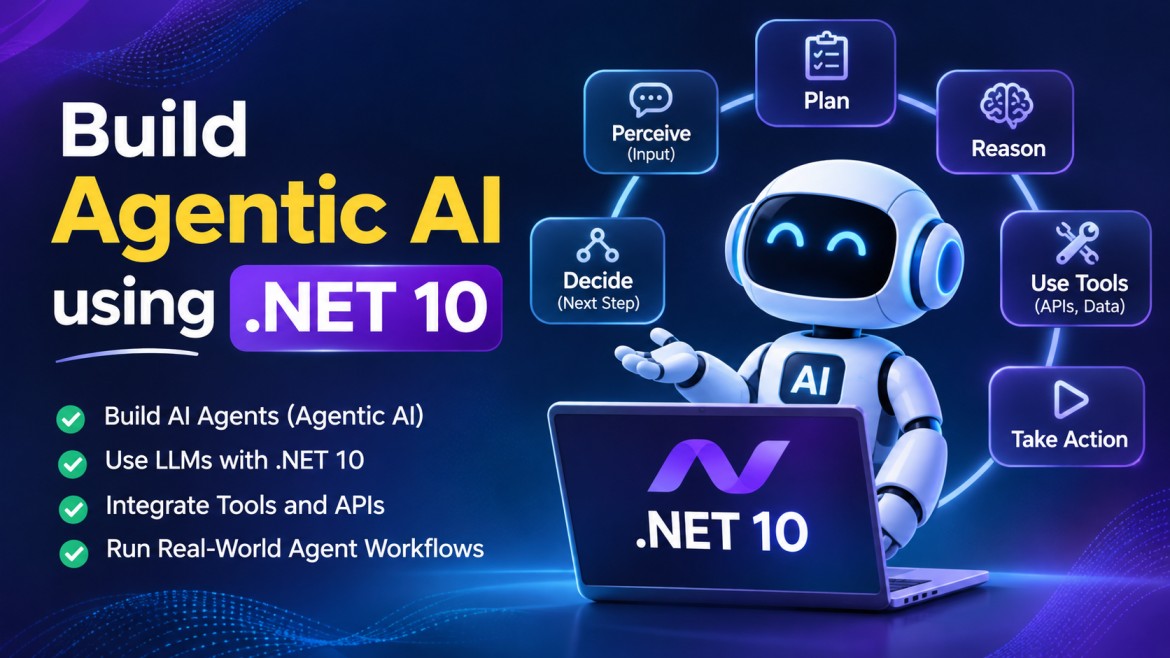


Microsoft Agent Framework and the .NET AI Ecosystem
Microsoft is building a broader .NET AI ecosystem to help developers create production-ready AI applications using technologies they already know. The ecosystem brings together .NET, Microsoft.Extensions.AI, Microsoft Agent Framework, Microsoft Foundry, Azure OpenAI, and .NET Aspire.
The important idea is that AI development is moving beyond simple experimentation. Organizations now need AI systems that are secure, observable, maintainable, scalable, and properly integrated with existing enterprise applications. This is where the Microsoft .NET ecosystem becomes important for enterprise developers.
From Python-Based AI Development to Enterprise AI
Python became the dominant language for AI development because its ecosystem grew extremely quickly. Developers could experiment with new models, libraries, and AI frameworks with very little setup. This made Python excellent for research and rapid prototyping.
However, production enterprise applications require more than experimentation. They need security, authentication, authorization, monitoring, logging, resilience, testing, governance, and long-term maintainability. Microsoft is therefore positioning .NET as a strong platform for building production-grade AI applications, particularly for organizations that already use C# and Azure.
This does not mean Python is becoming irrelevant. Python remains extremely important for AI research, data science, model development, and many AI frameworks. The key point is that .NET provides another strong option for building enterprise AI applications, especially when the surrounding business platform is already based on Microsoft technologies.
Microsoft's Approach: Integrating AI into Enterprise Applications
Microsoft's approach is centered around integration rather than isolation. Instead of treating AI as a completely separate system owned by a different team, AI capabilities can become part of the existing application architecture.
For a .NET organization, this means an AI component can work alongside existing Web APIs, databases, microservices, identity systems, cloud resources, and monitoring infrastructure. Developers can apply familiar enterprise practices rather than creating an entirely separate technology stack just for AI.
This also makes governance easier. AI applications can participate in the same authentication, authorization, networking, monitoring, and security policies used by other enterprise workloads.
Responsible AI and Security
Enterprise AI needs protection against problems such as inappropriate content, unsafe requests, prompt injection, excessive tool permissions, and accidental exposure of sensitive information.
The Microsoft ecosystem provides services and framework capabilities that help developers address these concerns. However, these technologies do not automatically make an application secure. Developers still need to design proper permissions, validation, guardrails, data protection, and human approval mechanisms.
The important idea is that responsible AI should be treated as part of the application architecture rather than something added at the end of development.
Why Use .NET for AI Development?
Strongly Typed Development
C# provides a strongly typed programming model. This is particularly useful when combining unpredictable AI behavior with deterministic application code.
For example, an LLM might generate an unpredictable response, but your application can require that response to be converted into a defined C# model before your business logic processes it.
public record CustomerRecommendation(
    string Product,
    decimal Price,
    string Reason);
This creates a clear contract between the AI-generated information and the rest of the application.
The AI may be probabilistic, but the surrounding application can still maintain strong contracts, validation, and predictable business logic.
Existing .NET Enterprise Capabilities
Another major advantage is that .NET developers do not have to abandon the architecture patterns they already use.
AI functionality can be integrated with familiar technologies such as:
- Dependency Injection
ILogger- ASP.NET Core
- HTTP clients
- Authentication and authorization
- Configuration
- Resilience patterns
- OpenTelemetry
- .NET Aspire
- Azure services
This allows AI to become another capability within the existing application architecture rather than creating a completely separate development model.
Observability
Observability becomes particularly important for AI applications because debugging an agent is more complicated than debugging a normal API.
A traditional application might have a simple flow:
Request → Service → Database → ResponseAn agent might have a much more complicated execution path:
User Request
     ↓
Agent
     ↓
LLM
     ↓
Tool
     ↓
API
     ↓
LLM
     ↓
Another Tool
     ↓
Final Response
Developers need visibility into questions such as which model was called, how long it took, how many tokens were consumed, which tools were invoked, and where failures occurred.
.NET Aspire and OpenTelemetry can help provide this visibility across the different components of an AI-enabled application.
Avoiding Vendor Lock-In
Another important part of the Microsoft AI ecosystem is abstraction.
Your application should ideally avoid tightly coupling its business logic to one particular AI provider. An application may start with Azure OpenAI but later need to use another model or a local model for a specific workload.
Framework-level abstractions can help separate the application from the underlying model provider.
Conceptually:
                Application
                    ↓
              AI Abstraction
                    ↓
       ┌────────────┼────────────┐
       ↓            ↓            ↓
 Azure OpenAI   Other Cloud    Local Model
This allows the application architecture to remain relatively stable while the underlying model can change based on cost, performance, privacy, capability, or business requirements.
What Can You Build with the .NET AI Ecosystem?
The ecosystem supports different levels of AI application complexity.
At the simpler level, applications can implement semantic search and classification. Instead of relying only on keyword matching, semantic search can understand the meaning behind a user's query. Classification can also help automatically categorize emails, support tickets, documents, or customer requests.
The next level is Retrieval-Augmented Generation (RAG). RAG allows an LLM to retrieve relevant information from an organization's own data before generating an answer. This is particularly useful for enterprise applications where the AI needs access to internal documentation, policies, product information, or business data.
At the more advanced level, we have AI agents and multi-agent systems. With the Microsoft Agent Framework, developers can create agents that use tools, reason about tasks, communicate with other agents, and work together to solve more complex business problems.
The Microsoft AI Stack
A simplified view of the ecosystem is:
                 AI Application
                      ↓
              .NET / ASP.NET Core
                      ↓
        Microsoft AI / Agent Framework
                      ↓
          Microsoft.Extensions.AI
                      ↓
        ┌─────────────┼─────────────┐
        ↓             ↓             ↓
   Azure OpenAI   Other Models   Local Models
        ↓
 Microsoft Foundry
        ↓
 Azure / Enterprise Infrastructure
        ↓
 .NET Aspire + OpenTelemetry
The important takeaway is that AI does not replace .NET architecture. Instead, AI becomes another capability that can be integrated into a well-designed .NET application.
For a .NET developer, this creates a natural path from existing skills such as C#, ASP.NET Core, Web API, DI, Azure, microservices, and distributed systems toward building production-grade AI and agentic applications.