

1. What is Monolithic Architecture?
Monolithic Architecture is an architecture where all major functionalities of an application are built and deployed as one application/unit.
For example, an E-commerce system may contain:
E-Commerce Application
│
├── User Module
├── Product Module
├── Order Module
├── Payment Module
├── Inventory Module
└── Notification Module
        │
        ↓
   Single Database
Even though the application contains different modules, they are normally part of the same application and deployment.
If we change only the Payment module, we generally build and deploy the entire application.
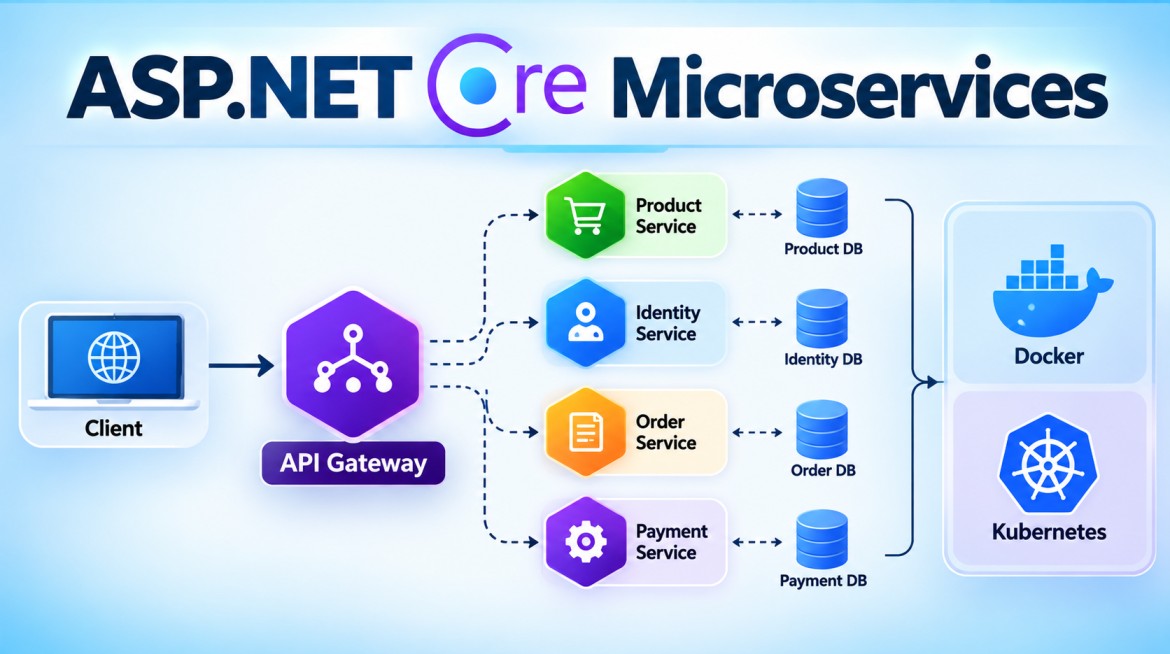
2. What is Microservices Architecture?
In Microservices Architecture, the application is divided into multiple small, independent services.
                    API Gateway
                         |
        ┌────────────────┼────────────────┐
        ↓                ↓                ↓
 Product Service    Order Service    Payment Service
        |                |                |
   Product DB         Order DB         Payment DB
Each service usually represents a specific business capability.
For example:
- Product Service → Product management
- Order Service → Order processing
- Payment Service → Payment processing
- Inventory Service → Stock management
Each service can generally be developed, deployed and scaled independently.
3. Why Do We Need Microservices?
A monolithic application is usually easier to start with.
But when the application becomes very large:
Large Application
      ↓
Large Codebase
      ↓
Many Development Teams
      ↓
Frequent Changes
      ↓
Deployment & Scaling Challenges
For example, suppose only the Payment module changes.
Monolithic
Change Payment
      ↓
Build Entire Application
      ↓
Test Entire Application
      ↓
Deploy Entire Application
Microservices
Change Payment Service
      ↓
Build Payment Service
      ↓
Test Payment Service
      ↓
Deploy Payment Service
This independent lifecycle is one of the main reasons organizations adopt microservices.
4. Main Differences
| Feature | Monolithic | Microservices |
|---|---|---|
| Application | Single application | Multiple services |
| Deployment | Entire application | Individual services |
| Database | Commonly shared | Prefer service-owned data |
| Scaling | Usually scale whole application | Scale required services |
| Development | Simpler initially | More complex |
| Communication | In-process calls | API / gRPC / Messaging |
| Failure | Can have wider impact | Better fault isolation |
| Debugging | Easier | More difficult |
| Team ownership | Often shared application | Teams can own services |
| Infrastructure | Relatively simple | More infrastructure required |
| Best suited | Small/medium or simpler systems | Large/complex systems |
5. Simple Real-Time Scenario
Assume an online shopping application receives very high traffic for Product Search, while Payment traffic is much lower.
Monolithic
E-Commerce Application
   Instance 1
   Instance 2
   Instance 3
   Instance 4
We may need to scale the entire application, even though Product functionality needs most of the additional capacity.
Microservices
Product Service
 ├── Instance 1
 ├── Instance 2
 ├── Instance 3
 └── Instance 4

Payment Service
 └── Instance 1
We can scale only the Product Service.
This is called independent scaling.
6. Advantages of Monolithic Architecture
- Simple to develop initially.
- Simple deployment.
- Easier debugging.
- Easier local development.
- Fewer network calls.
- Database transactions are simpler.
- Less infrastructure and operational complexity.
For a small or moderately complex application, a monolith can be a perfectly valid architecture.
7. Disadvantages of Monolithic Architecture
As the application becomes very large:
- Codebase can become difficult to maintain.
- Small changes may require full deployment.
- Independent scaling is difficult.
- Multiple teams can interfere with each other's releases.
- Technology changes can be harder.
- A serious application-level failure can have a broader impact.
8. Advantages of Microservices
Independent Deployment
One service can be deployed without necessarily redeploying others.
Independent Scaling
Scale only the service that needs additional capacity.
Team Independence
Team A → Product Service
Team B → Order Service
Team C → Payment Service
Fault Isolation
Failure of one service can be isolated when proper resilience mechanisms are implemented.
Smaller Codebases
Each service focuses on a particular business capability.
Technology Flexibility
Different services can use different technologies where there is a genuine requirement.
9. Disadvantages of Microservices
Microservices introduce significant distributed-system complexity.
Network Dependency
Order Service
      ↓ HTTP
Payment Service
The network can be slow or unavailable.
Distributed Transactions
Transactions across multiple services are much harder than transactions within a single database.
Patterns such as Saga may be required.
Harder Debugging
A request could travel through:
API Gateway
    ↓
Order Service
    ↓
Inventory Service
    ↓
Payment Service
Therefore, distributed tracing and centralized logging become important.
More Infrastructure
You may need:
- API Gateway
- Message Broker
- Centralized Logging
- Distributed Tracing
- Health Checks
- Docker
- Kubernetes/Container orchestration
- Monitoring
10. Key Points
- Monolithic = one deployable application.
- Microservices = multiple independently deployable services.
- Monolith is generally simpler to develop, test and deploy initially.
- Microservices provide better independent deployment and scaling.
- Microservices should normally be divided according to business capabilities/domain boundaries.
- Microservices commonly communicate using REST, gRPC or messaging.
- Prefer service-owned data in microservices.
- Microservices introduce network, monitoring and distributed transaction complexity.
- Microservices are not automatically better than monolithic architecture.
- For smaller systems, a monolith or modular monolith can often be the better engineering choice.
11. Interview Questions & Answers
Q1. What is the main difference between Monolithic and Microservices?
A monolithic application is built and deployed as a single unit, whereas microservices divide the application into multiple independently deployable services.
Q2. Which architecture is easier to develop?
Monolithic architecture is generally easier initially because deployment, debugging, communication and transactions are simpler.
Q3. Which architecture provides better scalability?
Microservices provide more granular scalability because individual services can be scaled independently.
Q4. Does every microservice require a separate database?
Not necessarily a separate physical database server, but each service should ideally own its data and other services should access that data through APIs or events rather than directly modifying its tables.
Q5. Are Microservices always better than Monolithic applications?
No. Microservices provide benefits for sufficiently complex systems, but they also introduce distributed-system and operational complexity.
Q6. How do microservices communicate?
Commonly through:
- REST APIs
- gRPC
- Message brokers such as RabbitMQ, Kafka or Azure Service Bus
Q7. Can we convert a Monolithic application into Microservices?
Yes. A common approach is to gradually extract suitable business capabilities into independent services rather than rewriting the entire system at once.
Interview One-Line Answer
Monolithic architecture builds and deploys the application as one unit, while Microservices Architecture divides it into independently deployable and scalable services aligned with business capabilities.