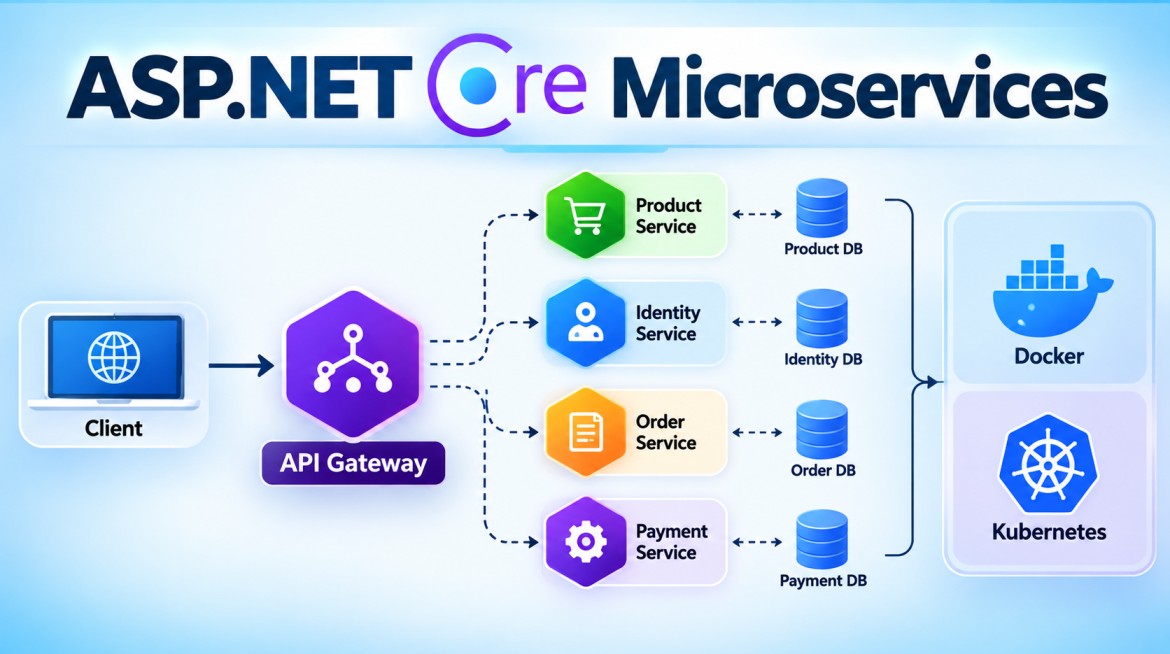


What Problems Does an API Gateway Solve?
In Microservices, an API Gateway solves problems caused by having many independently deployed backend services that clients need to access.
Without Gateway

Client
 ├──→ Product Service
 ├──→ Order Service
 ├──→ Payment Service
 ├──→ Inventory Service
 └──→ Customer Service
As the number of services increases, client communication and API management become more complicated.
With a Gateway:
Client
   |
   ↓
API Gateway
   |
   ├──→ Product Service
   ├──→ Order Service
   ├──→ Payment Service
   ├──→ Inventory Service
   └──→ Customer Service
1. Problem: Clients Must Know Every Service URL
Without a Gateway, the client may need to know:
product.company.com
order.company.com
payment.company.com
customer.company.com
If service locations change, client configuration may also need to change.
Solution
The Gateway provides a single public endpoint:
api.company.comand performs routing internally:
/products → Product Service
/orders   → Order Service
/payments → Payment Service
This reduces coupling between clients and the internal service topology.
2. Problem: Internal Architecture Is Exposed
Direct access can reveal how the backend is divided:
Client
   ├──→ Product Service
   ├──→ Pricing Service
   ├──→ Inventory Service
   └──→ Order Service
Clients become dependent on those internal boundaries.
Solution
The Gateway hides those implementation details:
Client
   ↓
API Gateway
   ↓
Internal Services
The backend can reorganize services while keeping the external API contract stable where possible.
3. Problem: Routing Becomes Complex
The system needs to determine which service should handle each request.
Solution
The Gateway centralizes routing:
GET /products/101
        ↓
Product Service

POST /orders
        ↓
Order Service

POST /payments
        ↓
Payment Service
4. Problem: Repeated Authentication Handling
Without centralized edge authentication:
Client → Product Service → Authentication
Client → Order Service   → Authentication
Client → Payment Service → Authentication
Solution
The Gateway can perform initial authentication before forwarding traffic:
Client
   |
   | JWT
   ↓
API Gateway
   |
Authenticate
   |
   ↓
Backend Service
This centralizes part of the security processing.
Important: Microservices should still enforce authorization appropriate to their own resources and trust boundaries.
5. Problem: Protecting Services from Excessive Traffic
A client may send too many requests:
Client
   |
   | Thousands of requests
   ↓
Microservice
This could overload the backend.
Solution
The Gateway can apply rate limiting:
Client
   ↓
API Gateway
   |
Rate Limiter
   |
   ↓
Microservice
Excess requests can be rejected, commonly with:
429 Too Many Requests6. Problem: Service Instances Change Dynamically
Suppose the Order Service scales from two instances to four:
Order Service

Instance 1
Instance 2
Instance 3
Instance 4
Clients should not need to know which instance to call.
Solution
The Gateway can work with load balancing and service-discovery infrastructure:
API Gateway
     ↓
Load Balancer / Service Discovery
     |
     ├──→ Instance 1
     ├──→ Instance 2
     ├──→ Instance 3
     └──→ Instance 4
The platform can add/remove healthy instances without exposing those details to the client.
7. Problem: Cross-Cutting Logic Gets Duplicated
Without centralized infrastructure, multiple services may independently implement:
Authentication
Rate Limiting
Request Logging
TLS handling
CORS
Request transformation
Solution
Some of these cross-cutting concerns can be handled at the Gateway.
             API Gateway
                  |
      ┌───────────┼───────────┐
      ↓           ↓           ↓
Authentication  Logging   Rate Limiting
                  |
                  ↓
             Microservices
This reduces unnecessary duplication, although service-specific concerns still belong inside individual services.
8. Problem: Client Makes Too Many Calls
Suppose one screen needs:
- Product information
- Price
- Inventory
- Reviews
Without aggregation:
Client
 ├──→ Product Service
 ├──→ Pricing Service
 ├──→ Inventory Service
 └──→ Review Service
The frontend has to coordinate four calls.
Solution
A Gateway or dedicated aggregation/BFF layer can sometimes combine the results:
Client
   |
   | One Request
   ↓
Gateway / Aggregator
   |
   ├──→ Product
   ├──→ Pricing
   ├──→ Inventory
   └──→ Reviews
   |
   ↓
Combined Response
This can simplify the frontend.
9. Problem: Different External and Internal API Formats
The public API may need to remain:
/api/productswhile an internal service changes to:
/catalog/v2/itemsSolution
A Gateway can perform request/response or route transformation:
Client
   |
/api/products
   ↓
Gateway
   |
Transform
   ↓
/catalog/v2/items
This can reduce the impact of some internal changes on external clients.
Advantages
Solving these problems provides:
- A single client entry point
- Reduced client-to-service coupling
- Centralized routing
- Better control of external traffic
- Centralized authentication at the edge
- Rate limiting
- API traffic logging and monitoring
- Request/response transformation
- Integration with service discovery/load balancing
- Optional response aggregation
Disadvantages
The Gateway itself introduces trade-offs:
- Additional infrastructure complexity
- Another network hop
- Potential latency
- Can become a bottleneck
- Can become a single point of failure if not highly available
- Routing/security configuration must be maintained
- Too much logic in the Gateway can create a new monolith
Key Points
A useful way to remember the problems it solves:
| Problem | API Gateway Solution |
|---|---|
| Many service URLs | Single entry point |
| Client knows internal services | Hides service topology |
| Complex routing | Centralized routing |
| Repeated edge authentication | Centralized authentication |
| Too many requests | Rate limiting |
| Dynamic service instances | Load-balancing/discovery integration |
| Repeated infrastructure logic | Cross-cutting policies |
| Too many frontend calls | Optional aggregation |
| Internal API changes | Transformation/abstraction |
API Gateway mainly solves client-to-Microservices communication and API-management complexity.
Interview Questions & Answers
Q1. What problems does an API Gateway solve?
Answer:
An API Gateway solves problems such as exposing multiple service endpoints to clients, complex routing, duplicated edge concerns, rate limiting, service-location changes, and client-side orchestration. It provides a single controlled entry point to the Microservices.
Q2. Does an API Gateway remove all duplicate code from Microservices?
Answer:
No. It can centralize common edge concerns such as routing, authentication, rate limiting, and request logging, but business logic and service-specific authorization still belong in the individual Microservices.
Q3. Does an API Gateway solve service discovery?
Answer:
It can integrate with service-discovery or platform networking mechanisms so clients don't need to know individual service instances.
Q4. What new problem can an API Gateway introduce?
Answer:
It adds another infrastructure component and network hop. If poorly designed, it can become a bottleneck or single point of failure, so production gateways should generally be highly available.
Interview-Ready Answer
An API Gateway solves the complexity of clients communicating directly with many Microservices. It provides a single entry point, hides internal service locations, centralizes routing, and can handle concerns such as authentication, rate limiting, logging, transformation, and integration with service discovery. It reduces client coupling to the internal Microservice architecture while providing a controlled API boundary.