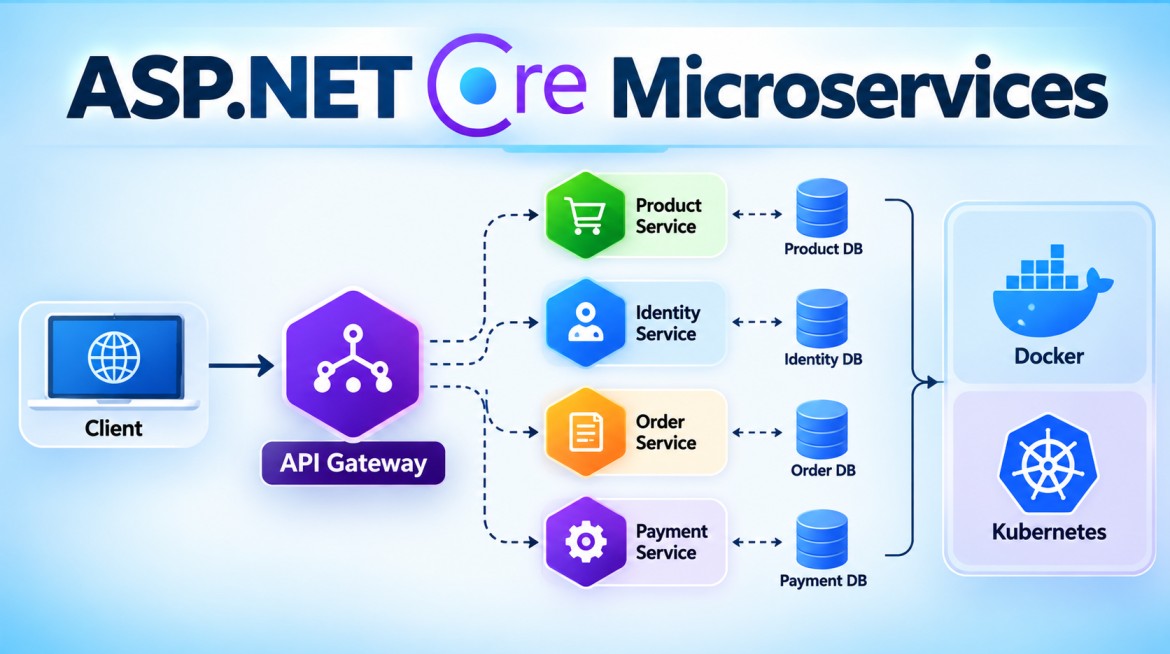


REST vs gRPC — What Is the Difference?
Both REST and gRPC are used for communication between applications and Microservices, but they differ in their communication model, data format, performance characteristics, and typical use cases.
1. What is REST?
REST (Representational State Transfer) is an architectural style commonly used to build HTTP APIs.
It typically uses:
- HTTP methods —
GET,POST,PUT,DELETE - JSON for request/response data
- Resource-oriented URLs
- Standard HTTP status codes
Example:
GET /api/products/101Response:
{
  "id": 101,
  "name": "Laptop",
  "price": 75000
}
Communication:
Order Service
      |
      | HTTP GET /api/products/101
      ↓
Product Service
      |
      | JSON
      ↓
Order Service
2. What is gRPC?
gRPC (Google Remote Procedure Call) is a high-performance RPC framework.
It typically uses:
- Protocol Buffers (Protobuf)
- HTTP/2
.protocontract files- Generated strongly typed client/server code
Example contract:
service ProductService {
    rpc GetProduct(ProductRequest)
        returns (ProductResponse);
}

message ProductRequest {
    int32 id = 1;
}
The client can then make a strongly typed call:
var product = await client.GetProductAsync(
    new ProductRequest { Id = 101 });
Communication:
Order Service
      |
      | GetProductAsync()
      | Protobuf / HTTP/2
      ↓
Product Service
3. REST vs gRPC — Main Difference
| Feature | REST | gRPC |
|---|---|---|
| Communication style | Resource-oriented | RPC / method-oriented |
| Typical data format | JSON | Protocol Buffers |
| Data representation | Text | Binary |
| Transport | HTTP/1.1, HTTP/2+ | HTTP/2 |
| Contract | Often OpenAPI | .proto |
| Strong typing | Depends on tooling | Built in through contract |
| Code generation | Optional | Standard workflow |
| Payload size | Usually larger | Usually smaller |
| Performance | Good | Often lower overhead |
| Human readable | Yes | Not on the wire |
| Browser support | Excellent | More limited; gRPC-Web may be needed |
| Streaming | Possible, varies | Built-in |
| Public APIs | Very common | Less common |
| Internal Microservices | Very common | Strong fit |
4. Communication Style
A major conceptual difference is resource vs method.
REST
REST usually works with resources.
GET /api/products/101
POST /api/orders
DELETE /api/products/101
You are essentially saying:
"Give me Product 101."
gRPC
gRPC exposes operations/methods.
GetProduct()
CreateOrder()
CheckInventory()
ProcessPayment()
You are essentially saying:
"Execute GetProduct."
So:
REST
Client → HTTP Verb + Resource → Service

gRPC
Client → Remote Method → Service
5. Data Format
REST — usually JSON
{
  "id": 101,
  "name": "Laptop",
  "quantity": 5
}
JSON is easy for humans to read and debug.
gRPC — Protobuf
Contract:
message ProductRequest {
    int32 id = 1;
    int32 quantity = 2;
}
The actual network payload is encoded in a compact binary format.
This generally means:
JSON
Readable
Larger textual representation

        vs

Protobuf
Binary
Compact representation
6. Performance
gRPC can have an advantage when services make frequent, latency-sensitive calls.
Reasons include:
- Binary Protobuf serialization
- Smaller payloads in many cases
- HTTP/2 multiplexing
- Efficient long-lived connections
- Built-in streaming
For example:
Order Service
   |
   ├──→ Inventory Service
   ├──→ Pricing Service
   ├──→ Product Service
   └──→ Shipping Service
If there are large numbers of internal calls, gRPC's lower protocol/serialization overhead can become useful.
However, don't assume gRPC is always faster enough to matter. For many business APIs, database queries, external dependencies, and application processing dominate the total response time.
7. Contract
REST
A REST API might expose:
GET /api/products/{id}and use OpenAPI/Swagger to document the contract.
gRPC
The contract is explicitly defined in .proto:
service ProductService {

    rpc GetProduct(ProductRequest)
        returns (ProductResponse);
}

message ProductRequest {
    int32 id = 1;
}

message ProductResponse {
    int32 id = 1;
    string name = 2;
    double price = 3;
}
From this contract, tooling generates strongly typed code.
This is one of gRPC's major advantages in a Microservices environment.
8. Streaming
gRPC has first-class support for four communication patterns:
1. Unary
   Request ─────────→
           ←──────── Response


2. Server Streaming
   Request ─────────→
           ←──────── Response
           ←──────── Response
           ←──────── Response


3. Client Streaming
   Request ─────────→
   Request ─────────→
   Request ─────────→
           ←──────── Response


4. Bidirectional Streaming
   Request  ────────→
            ←─────── Response
   Request  ────────→
            ←─────── Response
REST is most commonly used as:
Request → ResponseStreaming can be implemented with other HTTP technologies, but it is not the core REST interaction model in the same way.
9. Why Do We Need Both?
They solve overlapping communication problems but optimize for different requirements.
A Microservices architecture might use both:
                 Browser / Mobile
                       |
                  REST / JSON
                       |
                       ↓
                  API Gateway
                       |
                       ↓
                  Order Service
                  /     |      \
              gRPC    gRPC     gRPC
               /        |        \
              ↓         ↓         ↓
          Product    Inventory   Pricing
          Service     Service    Service
Here:
External communication
Client → REST → API GatewayInternal communication
Microservice → gRPC → MicroserviceThis is a reasonable pattern when the internal calls benefit from gRPC's characteristics.
10. Advantages
REST Advantages
- Simple and widely understood
- Excellent browser support
- Human-readable JSON
- Easy testing with tools such as Postman/curl
- Large ecosystem
- Well suited to public APIs
- Easy interoperability
gRPC Advantages
- Compact binary messages
- Strongly typed contracts
- Automatic client/server code generation
- HTTP/2
- Excellent streaming support
- Good fit for high-throughput internal communication
- Supports multiple programming languages
11. Disadvantages
REST Disadvantages
- JSON payloads can be larger
- JSON serialization/deserialization can add overhead
- Contracts can be less strict unless OpenAPI/schema tooling is used consistently
- Streaming isn't as integrated into the basic programming model
gRPC Disadvantages
- Binary payload isn't directly human-readable
- Debugging can require gRPC-aware tools
- Browser integration is less straightforward
.protocontracts must be maintained carefully- Can introduce unnecessary complexity for simple CRUD APIs
12. When Should You Use REST?
REST is often appropriate when:
- Building public APIs
- Supporting browser applications
- Building straightforward CRUD APIs
- Human-readable payloads are valuable
- Broad client compatibility is important
- Performance requirements don't justify additional complexity
Example:
Angular
   ↓
REST API
   ↓
ASP.NET Core
For your Angular frontend calling an ASP.NET Core Web API, REST/JSON is a natural default.
13. When Should You Use gRPC?
Consider gRPC when:
- Communication is primarily internal service-to-service
- Low latency matters
- Services communicate frequently
- Payload efficiency matters
- Strong contracts are important
- You need server/client/bidirectional streaming
- Multiple services/languages need generated clients
Example:
Order Microservice
        |
       gRPC
        ↓
Inventory Microservice
14. Key Points
- REST commonly uses HTTP + JSON.
- gRPC commonly uses HTTP/2 + Protobuf.
- REST is generally resource-oriented.
- gRPC is method/RPC-oriented.
- REST is easy to consume from browsers.
- gRPC provides strongly typed
.protocontracts. - gRPC has first-class streaming capabilities.
- gRPC can provide lower communication overhead.
- REST remains an excellent choice for many Microservices.
- You don't need to choose one technology for the entire system.
- REST and gRPC can coexist.
A useful way to remember:
REST
→ Simple
→ JSON
→ Browser friendly
→ Public APIs

gRPC
→ Compact binary messages
→ Strong contracts
→ Streaming
→ Internal service communication
Interview Questions & Answers
Q1. What is the main difference between REST and gRPC?
Answer:
REST is typically resource-oriented and exchanges JSON over HTTP, while gRPC is RPC-oriented, uses Protocol Buffers for strongly typed contracts, and normally communicates over HTTP/2.
Q2. Is gRPC always better than REST?
Answer:
No. gRPC can provide lower overhead and better streaming support, but REST is simpler and has broader browser and public API compatibility. The choice depends on the requirements.
Q3. Why can gRPC be faster than REST?
Answer:
gRPC commonly uses compact binary Protobuf messages and HTTP/2 features such as multiplexing and efficient connection reuse, which can reduce communication overhead.
Q4. Can REST and gRPC be used together?
Answer:
Yes. A system can expose REST APIs externally while using gRPC for internal Microservice communication.
Browser
   ↓ REST
API Gateway
   ↓
Order Service
   ↓ gRPC
Inventory Service
Q5. Which should you use between Microservices?
Answer:
REST is a good choice when simplicity, HTTP interoperability, and easy debugging are priorities. gRPC is useful when internal services require efficient communication, strict contracts, or streaming.
Interview-ready answer
REST typically uses resource-oriented HTTP APIs with JSON and is easy to consume from browsers and external clients. gRPC uses Protocol Buffers, HTTP/2, and strongly typed service contracts. For public or straightforward APIs, REST is often convenient. For high-performance internal Microservice communication or streaming, gRPC can be a strong choice. Both can be used in the same Microservices architecture.