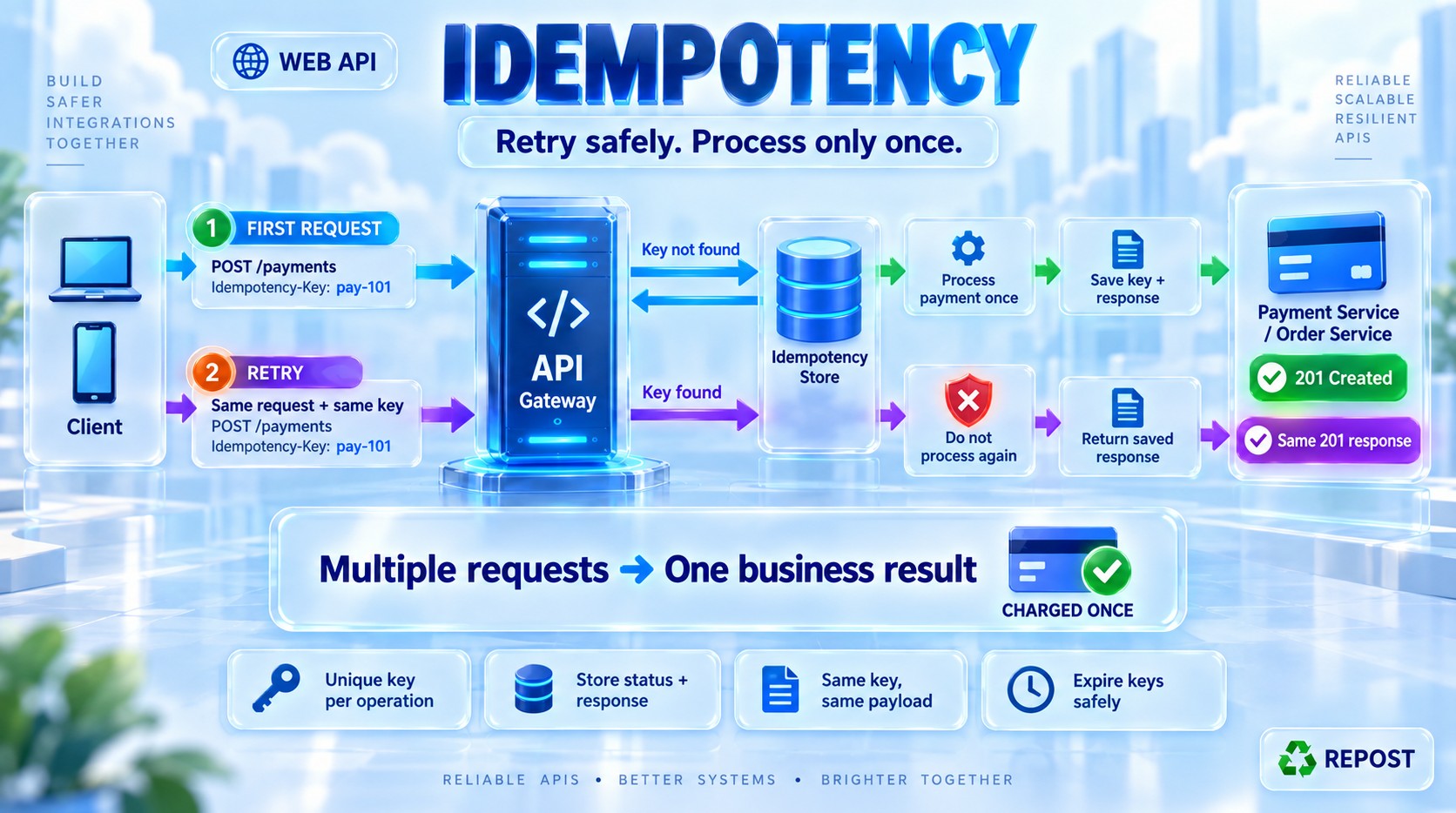


Stop Duplicate Payments! Master Idempotency in Web APIs
What is Idempotency?
Idempotency means sending the same request multiple times produces the same final result as sending it once.
For example, a customer clicks Place Order, but the response is delayed. The client retries the request:
POST /api/orders  → Order created: 1001
POST /api/orders  → Returns existing Order: 1001
POST /api/orders  → Returns existing Order: 1001
Only one order is created because every retry contains the same Idempotency-Key.
HTTP Methods
| Method | Idempotent? | Reason |
|---|---|---|
| GET | Yes | Reading repeatedly does not change data |
| PUT | Yes | Replaces the resource with the same state |
| DELETE | Yes | Resource remains deleted |
| PATCH | Depends | Some patch operations may repeatedly change data |
| POST | No, by default | Every request may create a new resource |
POST can be made idempotent by using an Idempotency-Key.
Complete ASP.NET Core Web API Example
This example uses:
-
ASP.NET Core Web API
-
Controllers
-
Entity Framework Core
-
SQL Server
-
Idempotency-Keyrequest header -
Database transaction
-
Unique constraint to prevent concurrent duplicates
1. Create the project
dotnet new webapi -n IdempotencyDemo
cd IdempotencyDemo
Install Entity Framework Core packages:
dotnet add package Microsoft.EntityFrameworkCore.SqlServer
dotnet add package Microsoft.EntityFrameworkCore.Tools
2. Project structure
IdempotencyDemo
│
├── Controllers
│   └── OrdersController.cs
├── Data
│   └── AppDbContext.cs
├── DTOs
│   ├── CreateOrderRequest.cs
│   └── OrderResponse.cs
├── Models
│   ├── Order.cs
│   └── IdempotencyRecord.cs
├── Program.cs
└── appsettings.json
3. Order model
Models/Order.cs
namespace IdempotencyDemo.Models;

public class Order
{
    public int Id { get; set; }

    public string CustomerName { get; set; } = string.Empty;

    public string ProductName { get; set; } = string.Empty;

    public int Quantity { get; set; }

    public decimal TotalAmount { get; set; }

    public DateTime CreatedAt { get; set; }
}
4. Idempotency record model
This table remembers which requests have already been processed.
Models/IdempotencyRecord.cs
namespace IdempotencyDemo.Models;

public class IdempotencyRecord
{
    public int Id { get; set; }

    public string IdempotencyKey { get; set; } = string.Empty;

    public string ResponseBody { get; set; } = string.Empty;

    public int StatusCode { get; set; }

    public DateTime CreatedAt { get; set; }
}
5. Request DTO
DTOs/CreateOrderRequest.cs
using System.ComponentModel.DataAnnotations;

namespace IdempotencyDemo.DTOs;

public class CreateOrderRequest
{
    [Required]
    public string CustomerName { get; set; } = string.Empty;

    [Required]
    public string ProductName { get; set; } = string.Empty;

    [Range(1, 100)]
    public int Quantity { get; set; }

    [Range(0.01, double.MaxValue)]
    public decimal TotalAmount { get; set; }
}
6. Response DTO
DTOs/OrderResponse.cs
namespace IdempotencyDemo.DTOs;

public class OrderResponse
{
    public int OrderId { get; set; }

    public string CustomerName { get; set; } = string.Empty;

    public string ProductName { get; set; } = string.Empty;

    public int Quantity { get; set; }

    public decimal TotalAmount { get; set; }

    public DateTime CreatedAt { get; set; }

    public string Message { get; set; } = string.Empty;
}
7. Database context
Data/AppDbContext.cs
using IdempotencyDemo.Models;
using Microsoft.EntityFrameworkCore;

namespace IdempotencyDemo.Data;

public class AppDbContext : DbContext
{
    public AppDbContext(DbContextOptions<AppDbContext> options)
        : base(options)
    {
    }

    public DbSet<Order> Orders => Set<Order>();

    public DbSet<IdempotencyRecord> IdempotencyRecords =>
        Set<IdempotencyRecord>();

    protected override void OnModelCreating(ModelBuilder modelBuilder)
    {
        modelBuilder.Entity<IdempotencyRecord>()
            .HasIndex(x => x.IdempotencyKey)
            .IsUnique();
    }
}
The unique index ensures that two simultaneous requests cannot save the same key.
8. Orders controller
Controllers/OrdersController.cs
using System.Text.Json;
using IdempotencyDemo.Data;
using IdempotencyDemo.DTOs;
using IdempotencyDemo.Models;
using Microsoft.AspNetCore.Mvc;
using Microsoft.EntityFrameworkCore;

namespace IdempotencyDemo.Controllers;

[ApiController]
[Route("api/[controller]")]
public class OrdersController : ControllerBase
{
    private readonly AppDbContext _context;

    public OrdersController(AppDbContext context)
    {
        _context = context;
    }

    [HttpPost]
    public async Task<ActionResult<OrderResponse>> CreateOrder(
        [FromBody] CreateOrderRequest request,
        CancellationToken cancellationToken)
    {
        string? idempotencyKey =
            Request.Headers["Idempotency-Key"].FirstOrDefault();

        if (string.IsNullOrWhiteSpace(idempotencyKey))
        {
            return BadRequest(new
            {
                message = "Idempotency-Key header is required."
            });
        }

        // Check whether this request was already processed.
        var existingRecord = await _context.IdempotencyRecords
            .AsNoTracking()
            .FirstOrDefaultAsync(
                x => x.IdempotencyKey == idempotencyKey,
                cancellationToken);

        if (existingRecord is not null)
        {
            var previousResponse =
                JsonSerializer.Deserialize<OrderResponse>(
                    existingRecord.ResponseBody);

            return StatusCode(
                existingRecord.StatusCode,
                previousResponse);
        }

        await using var transaction =
            await _context.Database.BeginTransactionAsync(
                cancellationToken);

        try
        {
            var order = new Order
            {
                CustomerName = request.CustomerName,
                ProductName = request.ProductName,
                Quantity = request.Quantity,
                TotalAmount = request.TotalAmount,
                CreatedAt = DateTime.UtcNow
            };

            _context.Orders.Add(order);

            await _context.SaveChangesAsync(cancellationToken);

            var response = new OrderResponse
            {
                OrderId = order.Id,
                CustomerName = order.CustomerName,
                ProductName = order.ProductName,
                Quantity = order.Quantity,
                TotalAmount = order.TotalAmount,
                CreatedAt = order.CreatedAt,
                Message = "Order created successfully."
            };

            var idempotencyRecord = new IdempotencyRecord
            {
                IdempotencyKey = idempotencyKey,
                ResponseBody = JsonSerializer.Serialize(response),
                StatusCode = StatusCodes.Status201Created,
                CreatedAt = DateTime.UtcNow
            };

            _context.IdempotencyRecords.Add(idempotencyRecord);

            await _context.SaveChangesAsync(cancellationToken);
            await transaction.CommitAsync(cancellationToken);

            return CreatedAtAction(
                nameof(GetOrder),
                new { id = order.Id },
                response);
        }
        catch (DbUpdateException)
        {
            await transaction.RollbackAsync(cancellationToken);

            // Another concurrent request may have used the same key.
            _context.ChangeTracker.Clear();

            var completedRecord = await _context.IdempotencyRecords
                .AsNoTracking()
                .FirstOrDefaultAsync(
                    x => x.IdempotencyKey == idempotencyKey,
                    cancellationToken);

            if (completedRecord is not null)
            {
                var previousResponse =
                    JsonSerializer.Deserialize<OrderResponse>(
                        completedRecord.ResponseBody);

                return StatusCode(
                    completedRecord.StatusCode,
                    previousResponse);
            }

            throw;
        }
    }

    [HttpGet("{id:int}")]
    public async Task<ActionResult<Order>> GetOrder(
        int id,
        CancellationToken cancellationToken)
    {
        var order = await _context.Orders
            .AsNoTracking()
            .FirstOrDefaultAsync(
                x => x.Id == id,
                cancellationToken);

        return order is null ? NotFound() : Ok(order);
    }

    [HttpGet]
    public async Task<ActionResult<List<Order>>> GetOrders(
        CancellationToken cancellationToken)
    {
        var orders = await _context.Orders
            .AsNoTracking()
            .OrderByDescending(x => x.CreatedAt)
            .ToListAsync(cancellationToken);

        return Ok(orders);
    }
}
9. Program.cs
using IdempotencyDemo.Data;
using Microsoft.EntityFrameworkCore;

var builder = WebApplication.CreateBuilder(args);

builder.Services.AddControllers();

builder.Services.AddDbContext<AppDbContext>(options =>
    options.UseSqlServer(
        builder.Configuration.GetConnectionString(
            "DefaultConnection")));

builder.Services.AddEndpointsApiExplorer();
builder.Services.AddSwaggerGen();

var app = builder.Build();

if (app.Environment.IsDevelopment())
{
    app.UseSwagger();
    app.UseSwaggerUI();
}

app.UseHttpsRedirection();

app.MapControllers();

app.Run();
10. Connection string
appsettings.json
{
  "ConnectionStrings": {
    "DefaultConnection": "Server=(localdb)\\MSSQLLocalDB;Database=IdempotencyDemoDb;Trusted_Connection=True;TrustServerCertificate=True"
  },
  "Logging": {
    "LogLevel": {
      "Default": "Information",
      "Microsoft.AspNetCore": "Warning"
    }
  },
  "AllowedHosts": "*"
}
11. Create the database
dotnet ef migrations add InitialCreate
dotnet ef database update
dotnet run
Testing the API
First request
POST /api/orders
Content-Type: application/json
Idempotency-Key: order-request-1001
{
"customerName": "Syed",
"productName": "Laptop",
"quantity": 1,
"totalAmount": 65000
}Response:
{
  "orderId": 1,
  "customerName": "Syed",
  "productName": "Laptop",
  "quantity": 1,
  "totalAmount": 65000,
  "createdAt": "2026-09-14T10:30:00Z",
  "message": "Order created successfully."
}
Status:
201 CreatedRetry with the same key
Send the exact request again:
Idempotency-Key: order-request-1001The API returns the stored response containing:
{
  "orderId": 1
}
It does not create Order 2.
New request
Change the key:
Idempotency-Key: order-request-1002Now the API creates a new order.
Request Flow
flowchart TD
    A["POST request"] --> B{"Idempotency-Key exists?"}
    B -- No --> C["Return 400"]
    B -- Yes --> D{"Key already stored?"}
    D -- Yes --> E["Return previous response"]
    D -- No --> F["Begin transaction"]
    F --> G["Create order"]
    G --> H["Store key and response"]
    H --> I["Commit transaction"]
    I --> J["Return 201 Created"]
Important Production Points
-
The client must generate a unique key for each logical operation.
-
The same retry must use the same key.
-
Store the key in a persistent database or distributed cache such as Redis.
-
Create a unique database index on the key.
-
Store the status code and response so retries receive the same result.
-
Use a transaction to save the business operation and idempotency record together.
-
Add an expiration time and periodically remove old records.
-
For payment APIs, also pass the idempotency key to the payment provider.
-
Ideally, store a request hash and reject the same key if it is reused with different request data.