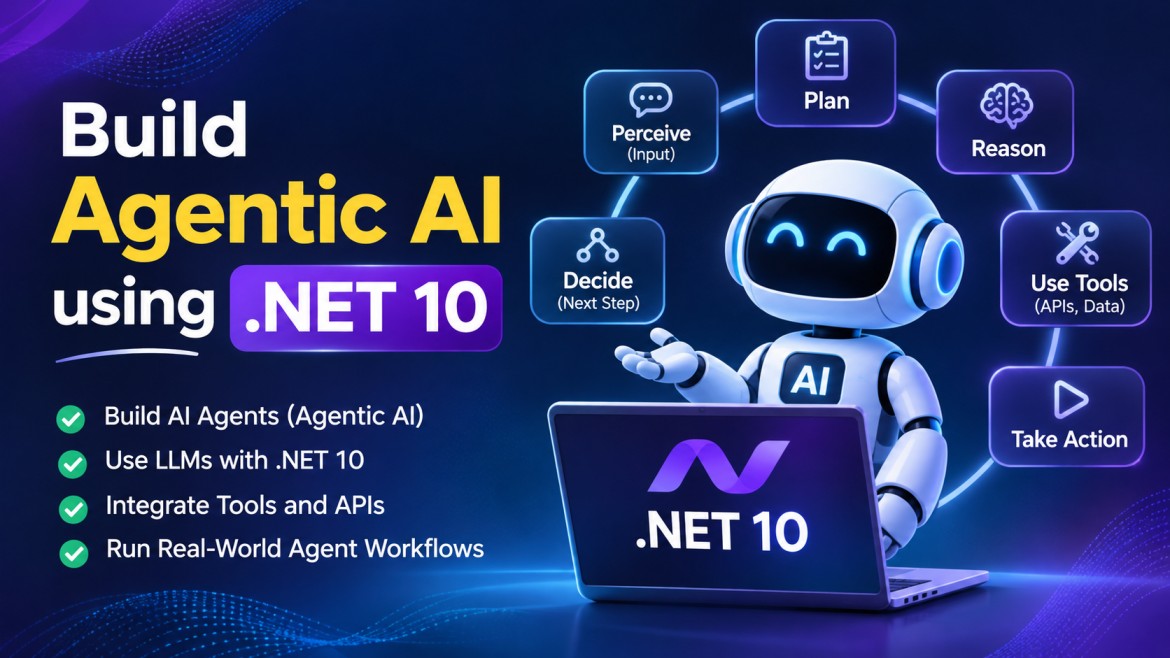


What Is an AI Agent?
An AI agent is a software system that can work toward a goal with some level of independence. Unlike a normal application where developers define every step, an agent can decide what steps are required and choose the appropriate tools to complete the task.
A simple way to understand this is to compare an agent with a human employee. If you ask an employee, “Find the best solution for this customer problem and prepare a response,” you normally don't explain every click and every action. You give them the objective and allow them to decide how to accomplish it. An AI agent works in a similar way. We give it a goal, provide the necessary capabilities, and allow it to determine the sequence of actions.
For example, imagine an e-commerce customer says:
“Find a suitable laptop under ₹80,000, check availability, and prepare the order.”
A traditional program might require a predefined workflow for every step. An AI agent can understand the request, search available products, compare the results, check inventory, and decide what should happen next.
AI Agent vs Normal Tool
A tool normally performs a specific operation when the application explicitly tells it what to do. For example, a calculator calculates numbers, a weather API returns weather information, and an email API sends an email.
An agent can decide when and why to use those tools. The agent may first search a product API, then use an inventory API, and finally call an order API based on the results. The important difference is not simply that the agent has tools; it is that the agent can select and sequence those tools based on its goal.
Normal Tool

Application → Tool → Result


AI Agent

Goal
  ↓
Agent decides what to do
  ↓
Tool/API
  ↓
Observe result
  ↓
Decide next action
  ↓
Another Tool/API
  ↓
Final Result
The Three Basic Abilities of an Agent
At a high level, an AI agent needs three important abilities: observe, think, and act.
Observe means receiving information from the environment. This could be a user request, database result, API response, email, document, or an event from another system. The agent needs this information to understand the current situation.
Think means interpreting the information and deciding what should happen next. An LLM commonly provides this reasoning capability. It can evaluate the current situation, consider the original goal, and determine the next appropriate action.
Act means interacting with the outside world. The agent might call an API, retrieve database information, send an email, create an order, execute a function, or ask another agent for assistance.
The Agentic Loop
These capabilities work together as a continuous cycle:
        Observe
           ↓
        Reason
           ↓
          Act
           ↓
     Observe Result
           ↓
        Reason
           ↓
       Next Action
This is commonly called the agentic loop. The important point is that the agent doesn't necessarily stop after one action. It examines the result of its previous action and uses that information to decide what to do next.
For example, an agent searching for a laptop might discover that the selected model is unavailable. Instead of simply returning an error, it can observe the result, reconsider the goal, search for another suitable model, compare it with the requirements, and continue until it can provide a useful result.
Goal-Driven and Autonomous
An AI agent is primarily goal-driven. The user normally describes what they want to achieve rather than specifying every technical step. The agent then determines the intermediate steps required to reach that objective.
It is also autonomous within the boundaries given to it. This does not mean the agent has unlimited freedom. Developers define its tools, permissions, business rules, security boundaries, and available data. Within those boundaries, the agent can make decisions and perform actions independently.
Reactive and Proactive
An agent can also respond to changes while it is working. This makes it reactive. For example, if an API returns an error or a product becomes unavailable, the agent can change its approach.
It can also be proactive when the architecture allows it to initiate work based on an event or condition. For example, an agent could monitor an incoming support request and start investigating the issue without requiring a person to manually start the investigation.
AI Agent: The Bigger Picture
So, an AI agent is not simply an LLM + a prompt. It is a software component that combines reasoning with the ability to observe information, make decisions, use tools, maintain context, and perform actions.
For a .NET developer, you can think of an agent as another layer in your application architecture:
User Goal
    ↓
AI Agent
    ↓
Reasoning / Decision
    ↓
Tools
 ┌──┼─────────────┐
 ↓  ↓             ↓
API Database    Services
    ↓
External Systems
The LLM provides the reasoning capability, while your .NET application provides the tools, APIs, business logic, data, security, and infrastructure. Combining these capabilities is what turns a simple LLM interaction into an AI agent.