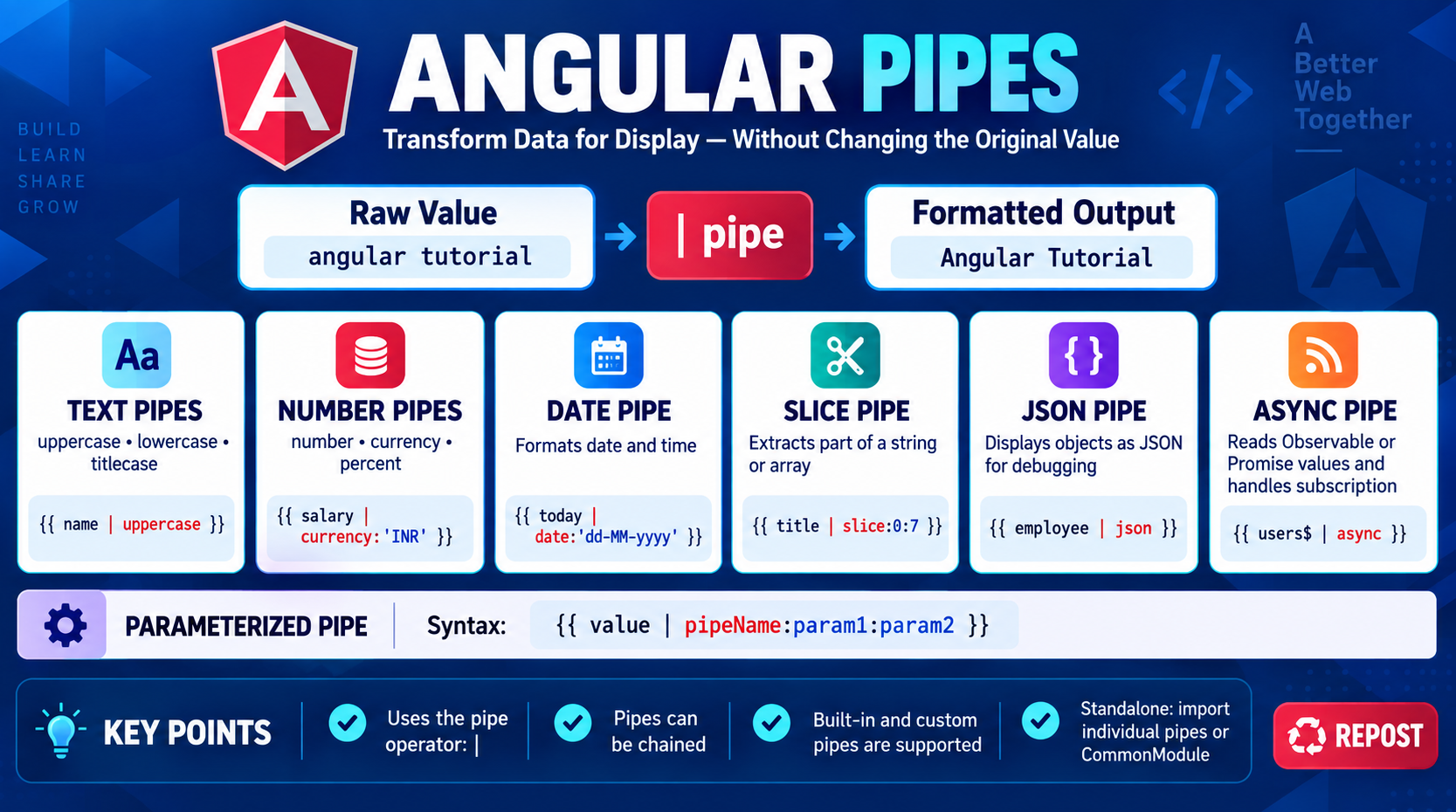


Angular Pipes & Angular Pipes Types
Angular Pipes
What Are Angular Pipes?
Angular Pipes transform data into a required display format inside an HTML template.
They change only how the data is displayed in the UI. They do not modify the original value stored in the component.
Pipe Syntax
A pipe is applied using the pipe symbol (|) in the template.
Some pipes also accept parameters, separated by a colon (:).
Why Are Pipes Used?
Pipes help developers:
-
Format text, numbers, dates and currency
-
Transform values directly in templates
-
Keep templates clean and readable
-
Reuse formatting logic across components
-
Display asynchronous data automatically
Types of Angular Pipes
Angular Pipes are broadly classified into:
1. Built-in Pipes
Angular provides several ready-to-use pipes for common data transformations.
Text Pipes
Used to transform text values.
-
uppercase– Converts text to uppercase -
lowercase– Converts text to lowercase -
titlecase– Converts the first letter of each word to uppercase
Number Pipes
Used to format numeric values.
-
numberordecimal– Formats decimal numbers -
percent– Converts a number into percentage format -
currency– Formats a number as currency
Date Pipe
The date pipe formats date and time values according to the required pattern and locale.
Slice Pipe
The slice pipe extracts and displays a specific portion of a string or array.
JSON Pipe
The json pipe converts an object into a readable JSON string. It is mainly useful during development and debugging.
KeyValue Pipe
The keyvalue pipe converts an object or map into an array of key-value pairs so that it can be iterated in a template.
Async Pipe
The async pipe works with Observables and Promises.
It automatically:
-
Subscribes to an Observable or Promise
-
Displays the latest emitted value
-
Unsubscribes when the component is destroyed
This helps prevent manual subscription handling and memory leaks.
2. Custom Pipes
A custom pipe is created when the required transformation is not available through Angular’s built-in pipes.
A custom pipe:
-
Uses the
@Pipedecorator -
Implements the
PipeTransforminterface -
Contains transformation logic in the
transform()method -
Can accept one or more parameters
-
Can be reused in multiple templates
Parameterized Pipes
Parameterized pipes allow additional values to control how the output is formatted.
Parameters are passed after the pipe name using the colon (:) symbol. A pipe can accept multiple parameters.
Common parameterized pipes include:
-
Date formatting
-
Decimal precision
-
Currency code and display style
-
Percentage formatting
-
String or array slicing
Chaining Pipes
Angular allows multiple pipes to be applied to the same value.
The output of one pipe becomes the input of the next pipe. Pipes are executed from left to right.
Pure Pipes
By default, Angular pipes are pure.
A pure pipe executes only when Angular detects:
-
A change in a primitive input value
-
A change in an object or array reference
-
A change in a pipe parameter
Pure pipes provide better performance because Angular does not execute them during every change-detection cycle.
Impure Pipes
An impure pipe can execute during every change-detection cycle.
It can detect internal changes to mutable objects and arrays even when their references remain unchanged.
However, impure pipes should be used carefully because frequent execution can affect application performance.
Pure Pipes vs Impure Pipes
| Feature | Pure Pipe | Impure Pipe |
|---|---|---|
| Default type | Yes | No |
| Execution | When input value or reference changes | During every change-detection cycle |
| Internal object changes | May not detect them | Can detect them |
| Performance | Better | Can be expensive |
| Recommended usage | Most transformations | Special cases only |
Import Details
In standalone Angular components, built-in pipes can be imported individually in the component’s imports array.
CommonModule can also be imported to make common built-in pipes and directives available.
A custom standalone pipe must also be added to the consuming component’s imports array.
In traditional NgModule-based applications, pipes are made available through the appropriate module imports and declarations.
Important Notes
-
Pipes are mainly intended for presentation-layer transformations.
-
Pipes should not modify the original input data.
-
Heavy calculations should not be performed inside pipes.
-
Pure pipes are preferred for better performance.
-
The
asyncpipe is recommended when displaying Observable or Promise values. -
Custom pipes are suitable for reusable display-formatting logic.
-
Business logic should remain in services or components instead of pipes.
Key Points
-
Angular Pipes transform values for display in templates.
-
The pipe operator is represented by
|. -
Pipes may accept parameters and can be chained.
-
Angular provides both built-in and custom pipes.
-
Pipes are pure by default.
-
Pure pipes execute when an input value or reference changes.
-
Impure pipes run frequently and may affect performance.
-
Pipes change the displayed output, not the original component data.