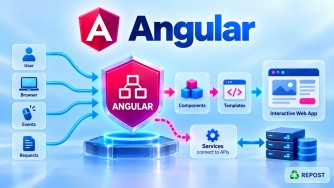


1. What is state management?
State management is the process of storing, updating, and sharing application data across components. It helps maintain consistent data and synchronize UI changes.
2. What is local component state?
Local component state is data managed within a single component, such as form values, counters, loading indicators, or selected tabs.
count = signal(0);
isLoading = signal(false);
3. How do you share state using Angular services?
Use an Angular singleton service with providedIn: 'root' to share state between components. Components inject the same service instance.
@Injectable({ providedIn: 'root' })
export class UserState { user = signal<User | null>(null); }
4. How do you manage state using Signals?
Use signal() to store reactive state, set() or update() to modify it, and computed() to derive values. Angular automatically updates dependent UI.
count = signal(0);
doubleCount = computed(() => this.count() * 2);
5. How do you manage state using RxJS?
Use BehaviorSubject to maintain shared state and expose it as an Observable. Components subscribe to receive state updates.
private usersSubject = new BehaviorSubject<User[]>([]);
users$ = this.usersSubject.asObservable();
6. What is NgRx?
NgRx is a reactive state management library for Angular based on Redux principles. It provides centralized state, predictable updates, and unidirectional data flow.
7. When would you use NgRx?
Use NgRx for large applications with complex shared state, multiple components, asynchronous workflows, and debugging requirements. For smaller applications, services with Signals are often sufficient.
8. What are Store, Action, Reducer, Selector, and Effect?
|
Concept |
Purpose |
|---|---|
|
Store |
Centralized application state |
|
Action |
Describes an event or state change |
|
Reducer |
Updates state based on actions |
|
Selector |
Retrieves or derives state |
|
Effect |
Handles side effects such as API calls |
Component → Dispatch Action → Reducer → Store
                                  |
Component ← Selector ←────────────┘

Action → Effect → Web API → Success/Failure Action
9. Service-based state vs NgRx — when should each be used?
|
Service-Based State |
NgRx |
|---|---|
|
Simple to implement |
More structured |
|
Uses Signals or RxJS |
Uses Store, Actions, Reducers |
|
Less boilerplate |
More setup and boilerplate |
|
Small/medium applications |
Large/complex applications |
|
Easier to maintain initially |
Better for complex state workflows |
Key Point: Start with services and Signals; introduce NgRx when application complexity justifies it.
10. Signals vs NgRx — what is the difference?
|
Signals |
NgRx |
|---|---|
|
Built into Angular |
External state management library |
|
Reactive value management |
Structured state architecture |
|
Minimal boilerplate |
Actions, reducers, selectors, effects |
|
Ideal for local/shared UI state |
Ideal for complex global state |
Key Point: Signals and NgRx are not mutually exclusive. Modern NgRx also supports SignalStore.
11. What state should be kept on the client versus the ASP.NET Core server?
Keep temporary UI state in Angular, such as filters, selected tabs, and loading indicators. Keep authoritative business data, permissions, and persistent records on the ASP.NET Core server.
Angular Client State
    ├── Selected Category
    ├── Search Filters
    ├── Loading Status
    └── Temporary Form Data
              |
              | HTTP / JSON
              v
ASP.NET Core Web API
    ├── Business Rules
    ├── Authorization
    ├── User Accounts
    └── Persistent Data → SQL Server
Important Interview Revision Points
|
Concept |
Key Point |
|---|---|
|
State Management |
Manage application data |
|
Local State |
Component-specific data |
|
Shared Service |
Share state between components |
|
|
Reactive state |
|
|
Derived state |
|
|
RxJS shared state |
|
NgRx |
Structured centralized state |
|
Store |
Holds application state |
|
Action |
Describes an event |
|
Reducer |
Updates state |
|
Selector |
Reads state |
|
Effect |
Handles asynchronous operations |
|
SignalStore |
NgRx signal-based state management |
|
Server State |
Authoritative business data |
Practical Example: Angular + ASP.NET Core
For an article management application:
-
Signals: Selected category, search text, sorting, loading status.
-
Angular Service: Share article filters between components.
-
RxJS: Handle API requests, search debouncing, and cancellation.
-
NgRx: Manage complex shared state if multiple features require coordinated updates.
-
ASP.NET Core: Enforce authorization, validate business rules, and persist articles in SQL Server.
Interview priority: Focus particularly on questions 1, 3, 4, 5, 6, 7, 8, 9, 10, and 11.
Key interview takeaway: Use Signals for reactive UI state, RxJS for asynchronous operations, services for shared state, and NgRx for complex application-wide state management.