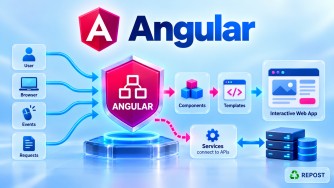


What Does ng build Do in Angular?
What is ng build?
ng build is an Angular CLI command that compiles your Angular application and generates the files needed to deploy/run it in a browser.
ng buildIn simple terms:
Angular Source Code
       ↓
    ng build
       ↓
Compile + Bundle + Optimize
       ↓
Deployable Files
       ↓
     dist/
Simple Example
Suppose your Angular application contains:
src/
├── app/
│   ├── app.ts
│   └── app.html
├── main.ts
├── styles.css
└── index.html
Run:
ng buildAngular processes these source files and produces output similar to:
dist/
└── my-app/
    └── browser/
        ├── index.html
        ├── main-ABC123.js
        ├── styles-XYZ456.css
        └── chunk-DEF789.js
The exact structure depends on your Angular version, builder, and rendering configuration.
What Happens Internally?
When you execute:
ng buildseveral things happen.
1. Angular Compiles the Application
Angular processes:
- TypeScript
- Angular components
- Templates
- CSS
- Routes
- Services
- Pipes
- Directives
For example, you write:
export class App {
  title = 'JN Tech';
}
The browser doesn't directly execute your TypeScript source. The build process transforms the application into browser-executable JavaScript.
2. Angular Compiles Templates
Suppose you have:
<h1>{{ title }}</h1>

@if (isLoggedIn) {
  <p>Welcome</p>
}
Angular compiles the template into efficient JavaScript instructions used by Angular at runtime.
3. Bundling Happens
Your project may contain many files:
app.ts
products.ts
product.service.ts
auth.service.ts
auth.guard.ts
login.ts
dashboard.ts
The build system processes these modules and creates deployable JavaScript bundles/chunks.
For example:
main-ABC123.js
chunk-XYZ789.js
So:
Many Angular/TypeScript files
            ↓
          Build
            ↓
Bundles and chunks
4. Tree Shaking Happens
Unused code can be removed from the production output.
Suppose:
function usedFunction() {
  console.log('Used');
}

function unusedFunction() {
  console.log('Not Used');
}

usedFunction();
Where safely possible, the build optimizer can eliminate unused code.
Used code      → Keep
Unused code    → Remove
This reduces bundle size.
5. Minification Happens
Production optimization makes JavaScript and CSS smaller.
For example, conceptually:
function calculateTotal(price, quantity) {
  return price * quantity;
}
can become compact generated code.
This reduces the amount of data the browser must download.
6. Code Splitting Can Happen
Suppose you lazy-load a component:
{
  path: 'products',
  loadComponent: () =>
    import('./products/products')
      .then(m => m.Products)
}
Angular can generate a separate chunk for that feature.
Application Start
      ↓
main.js loaded
      ↓
User visits /products
      ↓
Products chunk loaded
This can improve initial load performance.
7. Output Hashing
You may see:
main-ABC123.js
styles-XYZ789.css
instead of simply:
main.js
styles.css
The hash helps with browser caching.
If you deploy a new version:
Old:
main-ABC123.js

New:
main-KLM456.js
the changed filename tells the browser that this is a new asset.
8. Generates the dist Output
Finally, Angular writes the build result into the configured output directory, commonly:
dist/These are the files you deploy.
For example:
Angular Source
      ↓
ng build
      ↓
dist/my-app/browser/
      ↓
Web Server / Static Hosting
      ↓
Browser
ng serve vs ng build
This is an important interview distinction.
ng serve |
ng build |
|---|---|
| Primarily for development | Creates build artifacts |
| Starts development server | Doesn't itself deploy your application |
| Watches source files | Produces output files |
| Automatically rebuilds during development | Creates deployable bundles/chunks |
Commonly accessed through localhost:4200 |
Output commonly goes under dist/ |
Development:
ng serveProduction build:
ng buildor explicitly:
ng build --configuration productionng build vs ng build --configuration production
In modern Angular projects, the build target commonly has:
"defaultConfiguration": "production"Therefore:
ng buildusually uses the production build configuration in a standard CLI-generated project.
You can make it explicit:
ng build --configuration productionFor development configuration:
ng build --configuration developmentAlways check your project's angular.json because the default configuration can be changed.
Important: ng build Does Not Deploy
This is a common misunderstanding.
ng buildonly builds the application.
It doesn't automatically publish it to IIS, Azure, Nginx, etc.
The flow is:
Angular Source
      ↓
ng build
      ↓
dist/
      ↓
Deployment
      ↓
IIS / Nginx / Azure / Static Hosting
Angular + ASP.NET Core Example
In an Angular + ASP.NET Core Web API architecture:
Angular Source
     ↓
ng build
     ↓
Static Angular Files
     ↓
Web Server
     ↓
Browser
     ↓
HTTP/HTTPS
     ↓
ASP.NET Core Web API
     ↓
SQL Server
ng build builds the Angular frontend. It does not build your ASP.NET Core Web API.
The Web API is built separately, for example:
dotnet buildor published using:
dotnet publish -c ReleaseKey Points
ng buildis an Angular CLI command.- It compiles Angular and TypeScript code.
- It compiles Angular templates.
- It creates browser-ready JavaScript/CSS/assets.
- Production configuration performs optimizations such as minification and tree shaking.
- Lazy-loaded code can be split into separate chunks.
- Output hashing helps browser caching.
- Build output commonly goes into
dist/. ng buildbuilds the application; it does not itself deploy it.ng serveis primarily for development;ng buildcreates deployment artifacts.
Interview Questions and Answers
1. What does ng build do?
ng build compiles an Angular application and generates browser-ready build artifacts. Production builds also apply optimizations such as minification, tree shaking, code splitting, and output hashing.
2. Where does ng build put the generated files?
Usually under the configured:
dist/directory.
3. Does ng build start a web server?
No.
ng serve starts Angular's development server. ng build creates build artifacts.
4. Does ng build deploy the application?
No.
It creates the files that you subsequently deploy to IIS, Nginx, Azure, static hosting, or another hosting platform.
5. Does ng build compile TypeScript?
Yes. The Angular build pipeline compiles/processes the TypeScript application and generates JavaScript that browsers can execute.
6. What is the difference between ng serve and ng build?
ng serve
   ↓
Build + Development Server
   ↓
Local development

ng build
   ↓
Build Artifacts
   ↓
dist/
   ↓
Deployment
7. What is the production build command?
You can explicitly run:
ng build --configuration productionIn projects where production is configured as the default build configuration:
ng buildwill use it automatically.
Interview Quick Answer
ng buildcompiles the Angular application and produces optimized browser-ready files, such as JavaScript, CSS, and HTML, in the configured output directory—commonlydist/. A production build can perform optimizations such as minification, tree shaking, code splitting, and output hashing. The generated files can then be deployed to a web server or static hosting service.