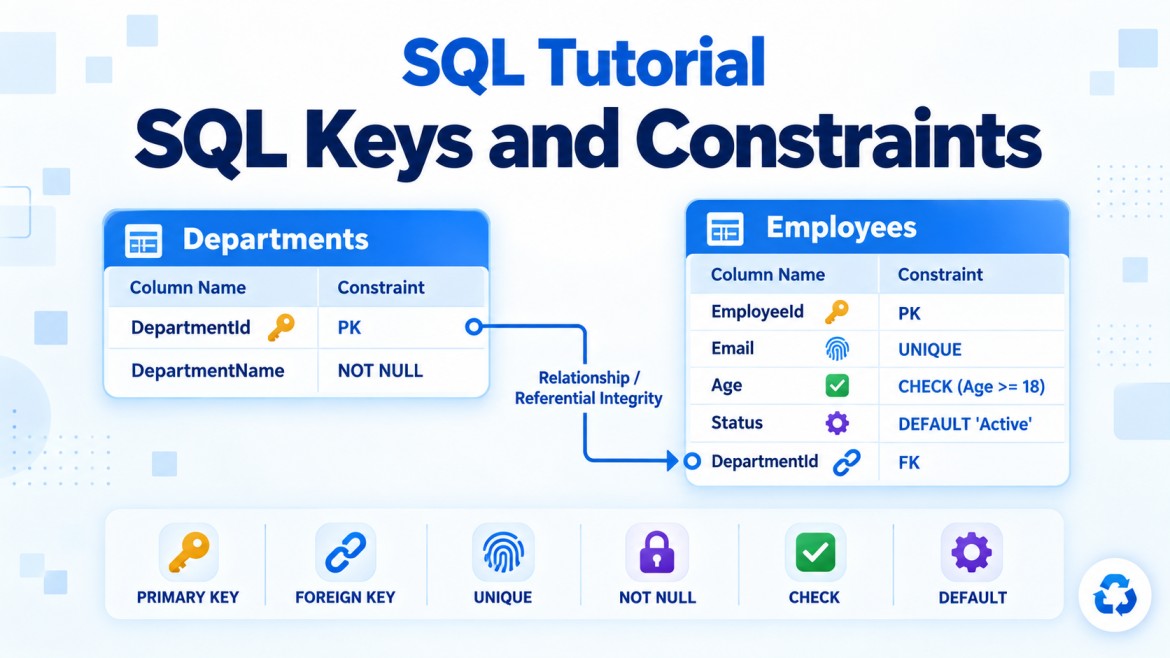


Keys in SQL Server
A key is one or more columns used to identify rows, enforce uniqueness, or create relationships between tables.
The main key types are:
-
Primary key
-
Unique key
-
Candidate key
-
Composite key
-
Foreign key
1. Primary Key
What is a primary key?
A primary key uniquely identifies every row in a table.
CREATE TABLE Employees
(
    EmployeeId INT PRIMARY KEY,
    EmployeeName VARCHAR(100),
    Email VARCHAR(150)
);
Here, EmployeeId uniquely identifies each employee.
Why do we need it?
-
To give every row a unique identity
-
To prevent duplicate records
-
To prevent
NULLidentifiers -
To reference rows from other tables
-
To maintain entity integrity
Rules
-
Values must be unique.
-
It cannot contain
NULL. -
A table can have only one primary key constraint.
-
The primary key may contain one or multiple columns.
-
SQL Server automatically creates a unique index to enforce it.
Example
INSERT INTO Employees VALUES (1, 'Arun', 'arun@example.com');
INSERT INTO Employees VALUES (2, 'Bala', 'bala@example.com');
The following statements fail:
-- Duplicate primary key
INSERT INTO Employees VALUES (1, 'Kumar', 'kumar@example.com');

-- NULL primary key
INSERT INTO Employees VALUES (NULL, 'Ravi', 'ravi@example.com');
Important point
A primary key is clustered by default in SQL Server only when another clustered index does not already exist. A primary key does not always have to be clustered.
CONSTRAINT PK_Employees
PRIMARY KEY NONCLUSTERED (EmployeeId)
2. Unique Key
What is a unique key?
A unique key ensures that duplicate values cannot be stored in a column or combination of columns.
CREATE TABLE Employees
(
    EmployeeId INT PRIMARY KEY,
    EmployeeName VARCHAR(100),
    Email VARCHAR(150) UNIQUE
);
Here:
-
EmployeeIdis the primary key. -
Emailis a unique key.
Therefore, two employees cannot have the same email address.
Why do we need it?
A table may have multiple columns that must be unique even though they are not the primary identifier.
Examples include:
-
Email address
-
Passport number
-
Aadhaar number
-
Employee code
-
Username
Rules
-
It prevents duplicate values.
-
A table can have multiple unique constraints.
-
In SQL Server, a regular unique constraint allows one
NULL. -
SQL Server creates a unique index to enforce the constraint.
-
It can be referenced by a foreign key.
Example
INSERT INTO Employees
VALUES (1, 'Arun', 'arun@example.com');

INSERT INTO Employees
VALUES (2, 'Bala', 'bala@example.com');
The following statement fails because the email already exists:
INSERT INTO Employees
VALUES (3, 'Kumar', 'arun@example.com');
Allowing multiple NULL values
A regular SQL Server unique constraint permits only one NULL. If you need multiple NULL values while enforcing uniqueness for non-NULL values, use a filtered unique index:
CREATE UNIQUE INDEX UX_Employees_Email
ON Employees(Email)
WHERE Email IS NOT NULL;
3. Candidate Key
What is a candidate key?
A candidate key is any minimal column or minimal combination of columns capable of uniquely identifying a row.
Consider the following employee data:
| EmployeeId | EmployeeCode | |
|---|---|---|
| 1 | EMP001 | arun@example.com |
| 2 | EMP002 | bala@example.com |
If all three columns are guaranteed to be unique, the candidate keys are:
-
EmployeeId -
EmployeeCode -
Email
One candidate key is selected as the primary key. The remaining candidate keys are called alternate keys.
For example:
-
Primary key:
EmployeeId -
Alternate candidate keys:
EmployeeCodeandEmail
Why do we need candidate keys?
Candidate keys help database designers:
-
Identify all possible unique identifiers
-
Choose the best primary key
-
Recognize other columns that require unique constraints
-
Design normalized tables correctly
What does “minimal” mean?
A candidate key must not contain unnecessary columns.
Suppose EmployeeId alone is unique:
(EmployeeId)Then this is not a candidate key:
(EmployeeId, EmployeeName)Although the combination is unique, EmployeeName is unnecessary because EmployeeId alone already identifies the row.
Such a combination is called a superkey, but it is not a candidate key because it is not minimal.
Is CANDIDATE KEY SQL syntax?
No. Candidate key is mainly a database-design concept.
It is normally implemented using:
-
PRIMARY KEY -
UNIQUEconstraints
CREATE TABLE Employees
(
    EmployeeId INT PRIMARY KEY,
    EmployeeCode VARCHAR(20) UNIQUE,
    Email VARCHAR(150) UNIQUE
);
All three are logically candidate keys because each can uniquely identify an employee.
4. Composite Key
What is a composite key?
A composite key is a key made from two or more columns.
The combination of the columns uniquely identifies a row.
Consider an OrderItems table:
| OrderId | ProductId | Quantity |
|---|---|---|
| 101 | 1 | 2 |
| 101 | 2 | 5 |
| 102 | 1 | 3 |
Neither OrderId nor ProductId is unique individually:
-
One order can contain several products.
-
One product can appear in several orders.
But this combination is unique:
(OrderId, ProductId)Why do we need it?
A composite key is useful when a row is naturally identified by a combination of values.
Common examples:
-
Order and product
-
Student and course
-
Employee and project
-
Invoice and item
-
Country and phone number
-
Tenant and user code
Example
CREATE TABLE OrderItems
(
    OrderId INT,
    ProductId INT,
    Quantity INT NOT NULL,

    CONSTRAINT PK_OrderItems
        PRIMARY KEY (OrderId, ProductId)
);
This is allowed:
INSERT INTO OrderItems VALUES (101, 1, 2);
INSERT INTO OrderItems VALUES (101, 2, 5);
This fails because the combination already exists:
INSERT INTO OrderItems VALUES (101, 1, 4);Important clarification
“Composite” describes the number of columns, not a separate constraint type.
A composite key can be:
-
A composite primary key
-
A composite unique key
-
A composite candidate key
-
A composite foreign key
Example of a composite unique key:
CONSTRAINT UQ_Bookings
UNIQUE (RoomId, BookingDate)
5. Foreign Key
What is a foreign key?
A foreign key is a column or combination of columns that refers to a primary key or unique candidate key in another table.
It creates a relationship between tables.
Example relationship
Departments
    DepartmentId — Primary Key

Employees
    DepartmentId — Foreign Key
Table creation
CREATE TABLE Departments
(
    DepartmentId INT PRIMARY KEY,
    DepartmentName VARCHAR(100) NOT NULL
);

CREATE TABLE Employees
(
    EmployeeId INT PRIMARY KEY,
    EmployeeName VARCHAR(100) NOT NULL,
    DepartmentId INT,

    CONSTRAINT FK_Employees_Departments
        FOREIGN KEY (DepartmentId)
        REFERENCES Departments(DepartmentId)
);
Why do we need it?
A foreign key:
-
Creates relationships between tables
-
Maintains referential integrity
-
Prevents invalid references
-
Reduces inconsistent data
-
Supports normalized database design
Valid example
INSERT INTO Departments
VALUES (10, 'Information Technology');

INSERT INTO Employees
VALUES (1, 'Arun', 10);
This works because department 10 exists.
Invalid example
INSERT INTO Employees
VALUES (2, 'Bala', 99);
This fails if department 99 does not exist.
Can foreign keys contain duplicate values?
Yes. Many employees can belong to the same department:
Employee 1 → Department 10
Employee 2 → Department 10
Employee 3 → Department 10
Therefore, foreign keys do not have to be unique.
Can foreign keys contain NULL?
Yes, if the column is nullable:
DepartmentId INT NULLA NULL value can mean that the employee has not yet been assigned to a department.
To make the relationship mandatory:
DepartmentId INT NOT NULLDelete and update behavior
SQL Server supports actions such as:
FOREIGN KEY (DepartmentId)
REFERENCES Departments(DepartmentId)
ON DELETE CASCADE
ON UPDATE CASCADE
ON DELETE CASCADE means deleting a parent row automatically deletes its related child rows. It must be used carefully because it can remove a large amount of related data.
Complete Practical Example
CREATE TABLE Departments
(
    DepartmentId INT,
    DepartmentCode VARCHAR(10) NOT NULL,

    CONSTRAINT PK_Departments
        PRIMARY KEY (DepartmentId),

    CONSTRAINT UQ_Departments_Code
        UNIQUE (DepartmentCode)
);

CREATE TABLE Employees
(
    EmployeeId INT,
    EmployeeCode VARCHAR(20) NOT NULL,
    Email VARCHAR(150) NOT NULL,
    EmployeeName VARCHAR(100) NOT NULL,
    DepartmentId INT NOT NULL,

    CONSTRAINT PK_Employees
        PRIMARY KEY (EmployeeId),

    CONSTRAINT UQ_Employees_Code
        UNIQUE (EmployeeCode),

    CONSTRAINT UQ_Employees_Email
        UNIQUE (Email),

    CONSTRAINT FK_Employees_Departments
        FOREIGN KEY (DepartmentId)
        REFERENCES Departments(DepartmentId)
);

CREATE TABLE Projects
(
    ProjectId INT PRIMARY KEY,
    ProjectName VARCHAR(100) NOT NULL
);

CREATE TABLE EmployeeProjects
(
    EmployeeId INT,
    ProjectId INT,
    AssignedDate DATE NOT NULL,

    CONSTRAINT PK_EmployeeProjects
        PRIMARY KEY (EmployeeId, ProjectId),

    CONSTRAINT FK_EmployeeProjects_Employees
        FOREIGN KEY (EmployeeId)
        REFERENCES Employees(EmployeeId),

    CONSTRAINT FK_EmployeeProjects_Projects
        FOREIGN KEY (ProjectId)
        REFERENCES Projects(ProjectId)
);
In this example:
-
Departments.DepartmentId→ Primary key -
DepartmentCode→ Unique key and candidate key -
Employees.EmployeeId→ Selected candidate key and primary key -
EmployeeCodeandEmail→ Unique keys and alternate candidate keys -
Employees.DepartmentId→ Foreign key -
(EmployeeId, ProjectId)→ Composite primary key -
EmployeeProjects.EmployeeIdandProjectId→ Foreign keys
Key Differences
| Feature | Primary Key | Unique Key | Candidate Key | Composite Key | Foreign Key |
|---|---|---|---|---|---|
| Main purpose | Identify each row | Prevent duplicate values | Possible minimal unique identifier | Identify using multiple columns | Create table relationships |
| Must be unique? | Yes | Yes | Yes | Depends on the key type | No |
Allows NULL? |
No | One NULL in a regular SQL Server unique constraint |
Logically, no | Depends on its constraint | Yes, if nullable |
| Number per table | One primary key constraint | Multiple | Multiple possible | Multiple possible | Multiple |
| Number of columns | One or more | One or more | One or more | Two or more | One or more |
| SQL constraint? | Yes | Yes | No; design concept | No; describes a multi-column key | Yes |
| Creates relationship? | Can be referenced | Can be referenced | Can be chosen/referenced when enforced | Can participate in relationships | Yes |
| Duplicates allowed? | No | No | No | No when used as a unique/primary key | Yes |
| Typical example | EmployeeId | EmployeeId, Email | OrderId + ProductId | DepartmentId in Employees |
Relationship Between the Keys
Suppose a table contains three minimal unique identifiers:
EmployeeId
EmployeeCode
Email
All three are candidate keys.
After selecting EmployeeId as the primary key:
Candidate keys
├── EmployeeId   → Primary key
├── EmployeeCode → Alternate key, enforced with UNIQUE
└── Email        → Alternate key, enforced with UNIQUE
If a candidate key requires multiple columns, it is also a composite candidate key.
Another table can store EmployeeId as a foreign key to reference the employee.
Key Points
-
A primary key is the selected main identifier for a table.
-
A unique key prevents duplicate values in additional columns.
-
A candidate key is any minimal set of columns capable of uniquely identifying a row.
-
The candidate key selected as the main identifier becomes the primary key.
-
Unselected candidate keys are called alternate keys.
-
A composite key contains two or more columns.
-
A foreign key creates and enforces a relationship between tables.
-
A primary or unique key can be composite.
-
A foreign key can contain duplicate values because many child rows may reference one parent.
-
A foreign key does not automatically create an index in SQL Server; indexing it is often beneficial for joins and parent-row updates or deletions.
-
Primary keys are not automatically
IDENTITY;IDENTITYmust be configured separately.
EmployeeId INT IDENTITY(1,1) PRIMARY KEYInterview answer
A primary key is the candidate key selected to uniquely identify each row. A unique key enforces uniqueness on other candidate columns. A candidate key is any minimal possible unique identifier. A composite key consists of multiple columns, while a foreign key references a primary or unique key to enforce relationships and referential integrity between tables.